Most days, the cleanest air you’ll breathe in Los Angeles is waiting before breakfast. By 3 p.m. in the valleys, a sky that looks perfectly clear can be holding the day’s worst smog, and nothing out the window gives it away. I stopped trusting that view years ago.
Early morning is your best bet across most of the basin. Ozone builds as the day heats up and usually peaks from the afternoon into early evening, hitting the inland valleys hardest. Your neighborhood and the season can shift that window, and wildfire smoke can erase it entirely. So before I head out, I pull up the live air quality index Los Angeles readings for my own area. One citywide number can hide a lot.
TL;DR Quick Answers
air quality index los angeles
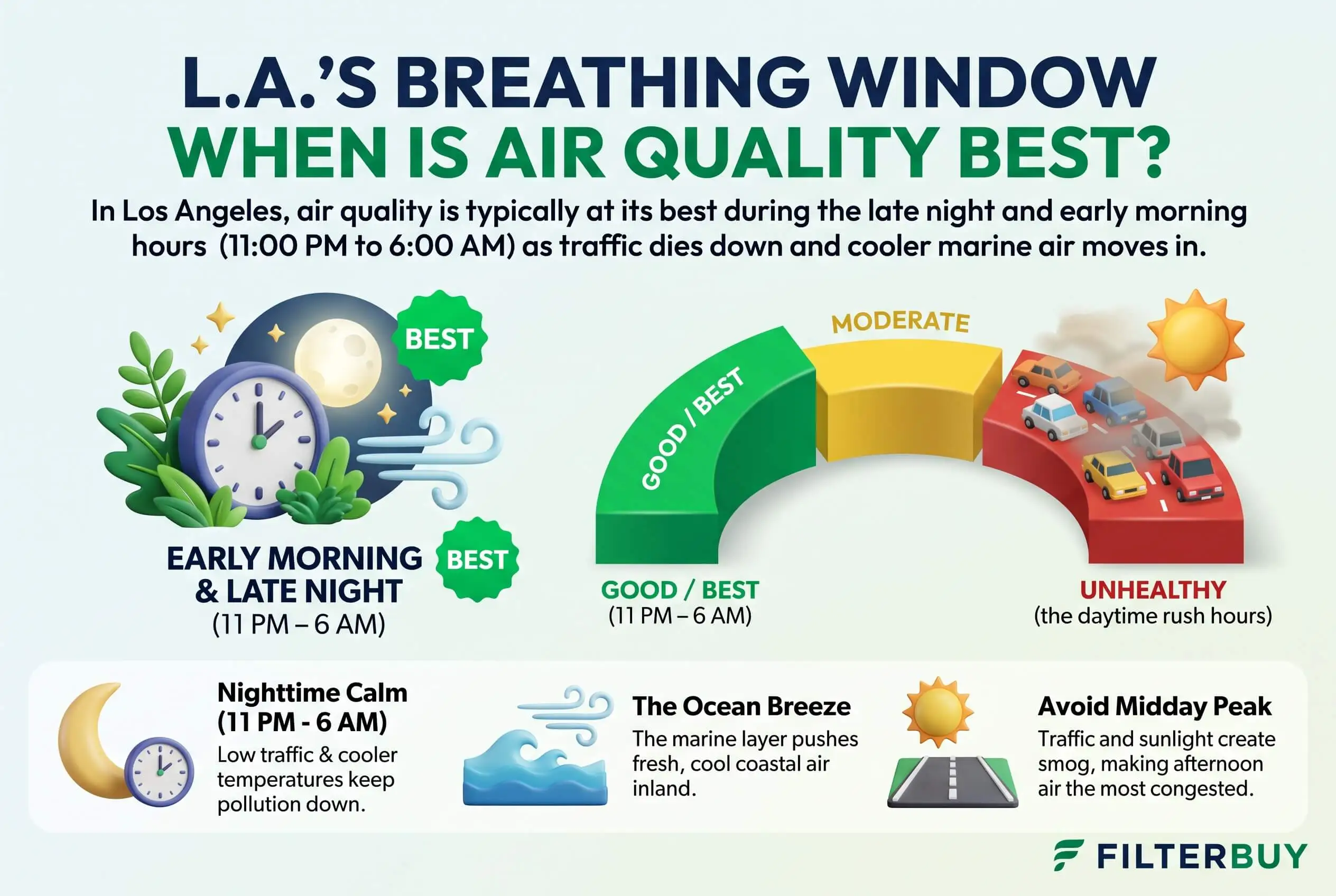
The air quality index (AQI) for Los Angeles rates air on a 0 to 500 scale using hourly readings from South Coast AQMD and AirNow monitors. Ozone and fine particles (PM2.5) drive most LA readings. The number shifts by hour and neighborhood, usually lowest in early morning and highest in inland valleys on summer afternoons.
What the colors mean: 0 to 50 is Good (green), 51 to 100 is Moderate (yellow), 101 to 150 is Unhealthy for Sensitive Groups (orange), and 151 and up runs from Unhealthy (red) to Hazardous (maroon).
Main pollutants: Ozone builds on hot, sunny afternoons, while PM2.5 rises with traffic, wildfire smoke and still winter nights.
Where to check: South Coast AQMD’s hourly map shows readings for your neighborhood, and its next-day forecast lets you plan ahead.
Read the driver, not just the number: Check which pollutant is behind the reading. Live values average recent hours, so they can lag behind fast changes like incoming smoke.
Clear skies can mislead: Ozone is invisible, so a blue afternoon can still read orange inland. Check before the kids head out to practice.
Protect indoor air on bad days: Close windows facing smoke or traffic, and run your HVAC fan with a MERV 8 filter if your system supports it.
Top Takeaways
Early morning is usually the cleanest time across most of the Los Angeles basin.
Ozone typically peaks from the afternoon into early evening, and the inland valleys get it worse.
If you live near a major freeway, expect commute-hour spikes even on clean days.
Wildfire smoke and Santa Ana winds can make any hour unhealthy, so the clock stops being a guide.
A live AQI reading paired with the next-day forecast beats any rule of thumb.
How Los Angeles Air Changes From Sunrise to Sunset
Early Morning: The Cleanest Window for Most of the Basin
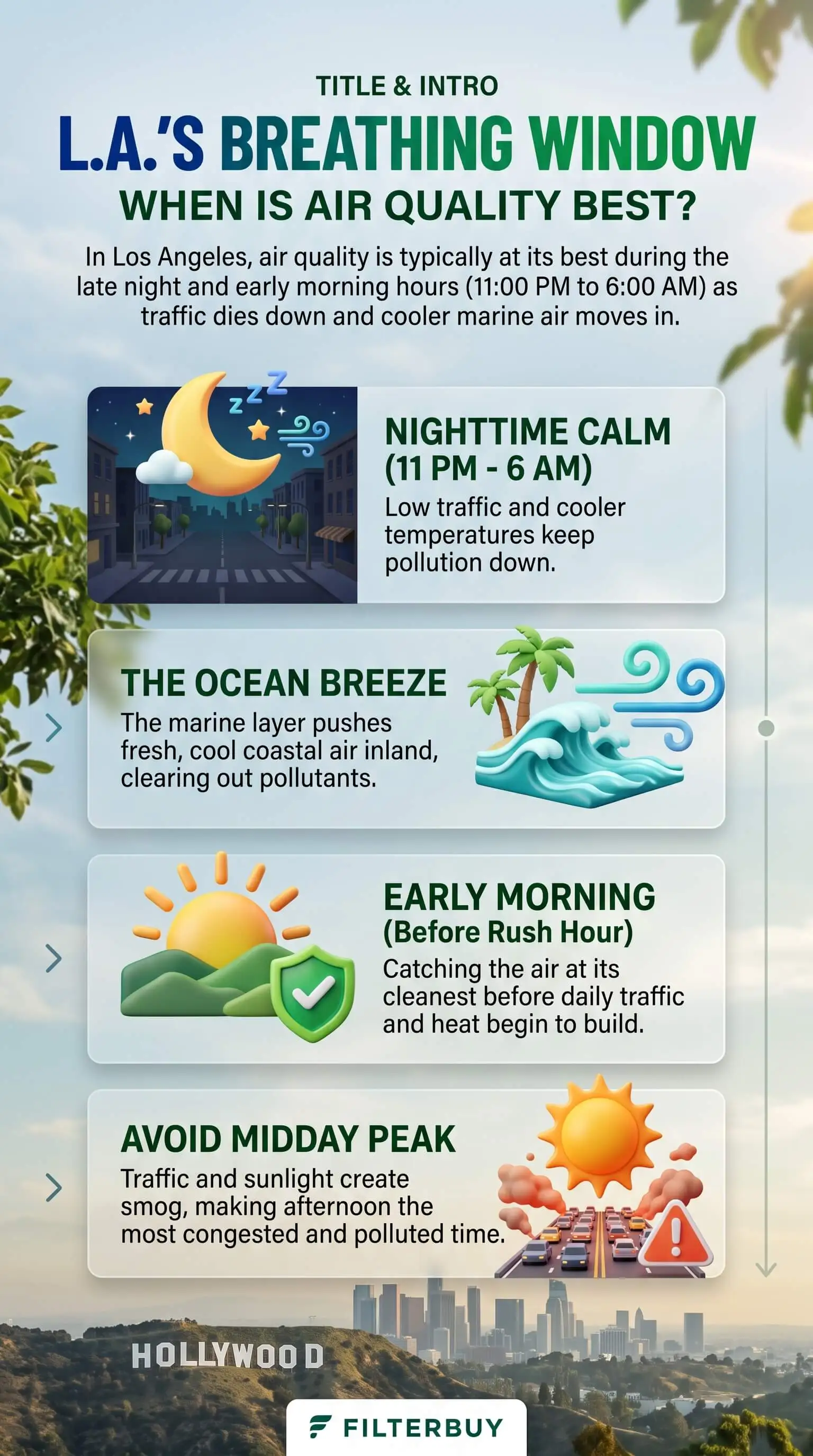
Without sunlight to drive it, yesterday’s ozone fades overnight. By sunrise it sits near its daily low across most of the basin. Freeway neighbors get one exception. On still mornings, a shallow layer of cool air can pin traffic exhaust near the ground until the sun warms it up, so the first commute hours beside a busy freeway aren’t automatically clean.
Morning Commute: Short Spikes Near Freeways
Rush hour pushes nitrogen dioxide and fine particles (PM2.5) up along the busiest corridors, including the 5, 10, 110, 405, and 710. Those spikes stay local. A few blocks away, the air often reads noticeably cleaner.
Midday to Early Evening: Ozone Builds and Moves Inland
Here’s the part you can’t see. Over several hours, sunlight cooks the morning commute’s exhaust into ground-level ozone. Meanwhile, the afternoon sea breeze carries that air off the coast and into the San Fernando Valley, the San Gabriel Valley, and the Inland Empire. South Coast AQMD ozone alerts point to the afternoon and early evening for the highest levels, and inland neighborhoods feel it most.
Night: Ozone Fades, Particles Can Linger
Once the sun sets, ozone stops forming and levels fall. Evening traffic still adds particles, though. On calm winter nights, a low inversion can hold them close to the ground until morning. For homeowners concerned about particles entering their indoor air, air ionizer installation may be worth exploring, provided the system does not produce harmful levels of ozone.
Why Your Neighborhood Changes the Answer
Santa Monica and Pomona don’t share the best hour.
Coastal neighborhoods: Ocean air reaches you first, and afternoon ozone usually runs lower than it does inland.
Inland valleys: Mornings often start clean, but the sea breeze drops the afternoon smog here, frequently later in the day.
Near major freeways: Commute hours bring the worst traffic pollution, even when the rest of the city reads clean.
Foothill and valley edges: On still, hot days, the mountains can hold polluted air in place.
How the Seasons Shift LA’s Best Hours
May through September: This is ozone season. Protect your mornings, and give hot, sunny, still afternoons the most caution.
Fall: Santa Ana winds and wildfire smoke can make any hour unhealthy, early morning included. Once smoke moves in, the clock stops being a reliable guide.
Winter: Ozone drops off, but cold, calm nights and mornings can trap particles near the ground.
Fourth of July: Fireworks can send particle levels spiking overnight.
How to Read the Air Quality Index Los Angeles Readings Before You Head Out
The Air Quality Index runs from 0 to 500 and sorts every reading into six color bands:
0 to 50, Good (green): Get outside and enjoy it.
51 to 100, Moderate (yellow): Most people are fine. Unusually sensitive people should ease up.
101 to 150, Unhealthy for Sensitive Groups (orange): Kids, older adults, and anyone with asthma or heart disease should cut back.
151 to 200, Unhealthy (red): Everyone should limit long or hard exertion.
201 to 300, Very Unhealthy (purple): Move activities indoors.
301 and up, Hazardous (maroon): Stay inside and keep your indoor air clean.
A single number won’t tell you what’s coming, so I always check which pollutant is behind it. Ozone builds through the afternoon. PM2.5 tends to hang low and linger. Monitoring agencies also calculate live readings from weighted averages of recent hours, which means a fast change like incoming smoke can outrun the number on your screen. Pair the live reading with South Coast AQMD’s next-day forecast and you can plan a day ahead instead of scrambling.
How I Plan Outdoor Time Around LA’s Air
Runs, walks, and practices: I book them early, especially from May through September.
Windows: Open them in the cool morning for fresh air. If you live inland, close them before the afternoon peak.
Alert days: Move hard workouts indoors and give sensitive family members an easier day.
Indoor air: Shutting the windows only helps if something is cleaning the air inside. On bad days, a well-fitted HVAC filter and a portable purifier in the bedroom do most of the work, and this guide on how HVAC filtration helps during high AQI days in Los Angeles walks through the details.
“Years of checking Los Angeles readings before every run taught me that the 7 a.m. number says almost nothing about 3 p.m. in the valleys. The commute’s exhaust is still cooking in the sun and riding the sea breeze inland, so the cleanest hour is nearly always the earliest one you can get out the door.”
7 Essential Resources
Check Live AQI for Your Exact Neighborhood
South Coast AQMD’s hourly AQI map and monitoring-site data show what’s happening in your area instead of a citywide average. View South Coast AQMD current air quality data
Turn a Raw Pollutant Reading Into an AQI Number
AirNow’s calculator converts raw PM2.5 or ozone readings into AQI values and back. Use the AirNow AQI calculator
Watch Heat, Wind, and Air Alerts in One Place
The National Weather Service’s Los Angeles/Oxnard office posts heat advisories and Santa Ana wind warnings, which often land on the region’s worst air days. Visit NWS Los Angeles/Oxnard
See Why the Coast Usually Breathes Easier
The National Park Service explains why the Santa Monica Mountains and coastal areas tend to get better air than the interior valleys, and why summer inversions drive ozone up. Read the Santa Monica Mountains air quality overview
Know What LA County Recommends During Smoke Advisories
LA County Public Health’s May 2026 smoke advisory spells out who should stay inside, when to cancel outdoor sports, when an N95 mask makes sense, and how to keep indoor air clean. Read LA County Public Health’s smoke advisory guidance
Prepare Your Household for Wildfire Smoke
The California Department of Public Health’s wildfire toolkit covers smoke, ash, evacuation, and mental health, in English and Spanish. Explore the CDPH wildfire safety toolkit
Understand How Outdoor Air Data Gets Tracked
The CDC breaks down how monitored and modeled air data come together to guide public health decisions. See the CDC’s outdoor air quality tracking
3 Statistics
According to the U.S. Environmental Protection Agency, ozone usually peaks in the afternoon when sunlight is strongest, and places downwind of the source can peak later in the afternoon or evening. Thanks to the sea breeze, LA’s inland valleys sit right in that downwind zone.
The American Lung Association’s State of the Air 2026 report once again named Los Angeles-Long Beach the most ozone-polluted metro area in the country, with 159.2 unhealthy ozone days a year.
Children spend nearly twice as much time outdoors as adults, and the California Air Resources Board notes that this puts them at greater risk from ozone. Scheduling kids’ outdoor time early is one of the easiest ways to cut that exposure.
Los Angeles experiences some of the nation's highest ozone pollution levels, especially during the afternoon, putting children who spend more time outdoors at greater risk. Scheduling outdoor activities earlier in the day can help reduce exposure, while using a high quality filter at home can help capture airborne particles indoors, though it cannot remove ozone on its own.
Final Thoughts and Opinion
I gave up hunting for one perfect hour a long time ago, because the basin doesn’t work that way. What it does have is a pattern you can plan around. Mornings usually win. Inland afternoons in ozone season deserve real respect, and when smoke rolls in, it overrides everything else. The live reading for your neighborhood should always get the final vote.
Don’t take the air you breathe for granted just because the sky looks blue. Ozone is invisible, and a clear afternoon can still be a rough one for your lungs. If you’re the one keeping the family’s plans on track, a quick check before everyone heads out is one of the simplest ways to protect them. Other cities play by different rules, as this look at the best time of day for air quality in Chicago shows.
Frequently Asked Questions
Is Los Angeles air quality better in the morning or evening?
Morning, most of the time. Ozone fades overnight and rebuilds once the sun is up, so summer evenings can still carry the tail of the afternoon peak, especially inland. The evening commute adds particles, too. If evening is the only time you’ve got, check the live reading first.
Which parts of Los Angeles usually have the cleanest air?
Coastal neighborhoods generally get cleaner air than the interior valleys. Ocean air reaches them first, and the afternoon sea breeze carries smog inland. Freeway distance still matters, though. A coastal home next to a busy freeway can see sharp rush-hour spikes.
Is it safe to exercise outside in LA in the afternoon?
Often, yes. Summer afternoons are still the riskiest time for hard exercise, especially inland, because deep breathing pulls more ozone into your lungs. Once the AQI tops 100, sensitive groups should switch to a lighter workout or an earlier slot. Above 150, that advice covers everyone. When outdoor air quality is poor, staying indoors with a high-quality air purifier equipped to remove the relevant pollutants can also help reduce exposure.
Does the marine layer make LA air better or worse?
At the coast, a gray marine layer morning usually means clean air. The temperature inversion sitting on top of that layer works like a lid over the basin, though, and on hot days it can hold pollution in place farther inland. Gray skies alone won’t tell you much, so check the reading.
What months have the worst air quality index in Los Angeles?
Ozone hits hardest from May through September, when heat and sunlight speed up smog formation. Fall can bring wildfire smoke and Santa Ana events, and winter can trap particles on cold, still mornings. For the full picture at home, pair your outdoor checks with indoor air quality testing.
Check Today’s Air Before You Head Out
The daily pattern shows you which hours to check first, and the live reading for your neighborhood shows you what today actually looks like. Pull up the current air quality index for your part of Los Angeles before your next run or practice, and plan your time outside so you and your family can breathe easier. At home, an HVAC air purifier ionizer may also be worth considering as part of your indoor air quality plan.