Pull a 20x25x2 out of the cabinet after a long summer and the pleats show you exactly how hard your system worked. That gray layer is dust, pollen and pet dander you never saw floating through the house, and all of it stood between your blower and the air it needs.
A 20x25x2 air filter is a two-inch pleated HVAC filter with an actual cut of 19 1⁄2 × 24 1⁄2 × 1 3⁄4 inches. Choosing the right one comes down to a snug fit and a MERV rating your blower can handle, backed by a change schedule that follows the seasons.
For a long time I treated filter shopping as a quarterly chore. Then I realized the same slot feeds both my furnace and my air conditioner, so one filter carries the load all year. This is how I'd pick a 20x25x2 so your system breathes easily from the first cold snap to the last heat wave.
TL;DR Quick Answers
20x25x2 air filter
A 20x25x2 air filter is a two-inch pleated HVAC filter that actually measures 19 1⁄2 × 24 1⁄2 × 1 3⁄4 inches. In a central system, that one filter serves both your furnace and your air conditioner, so it works every month of the year. Choose the highest MERV your blower can handle and change it at least every 90 days.
Size: Order by the nominal 20x25x2 name. A 25x20x2 is the same filter.
Depth: Two inches of pleated media lets air through with less resistance than a one-inch filter at the same MERV.
MERV: 8 for everyday dust, 11 for pets and pollen, 13 for smoke, if your system supports it.
Schedule: Every 90 days, every 60 with a pet, about every 45 with several pets or allergies. Check monthly in peak heating and cooling months.
Fit: Point the airflow arrow toward the blower, and never put a one-inch filter in a two-inch track.
Top Takeaways
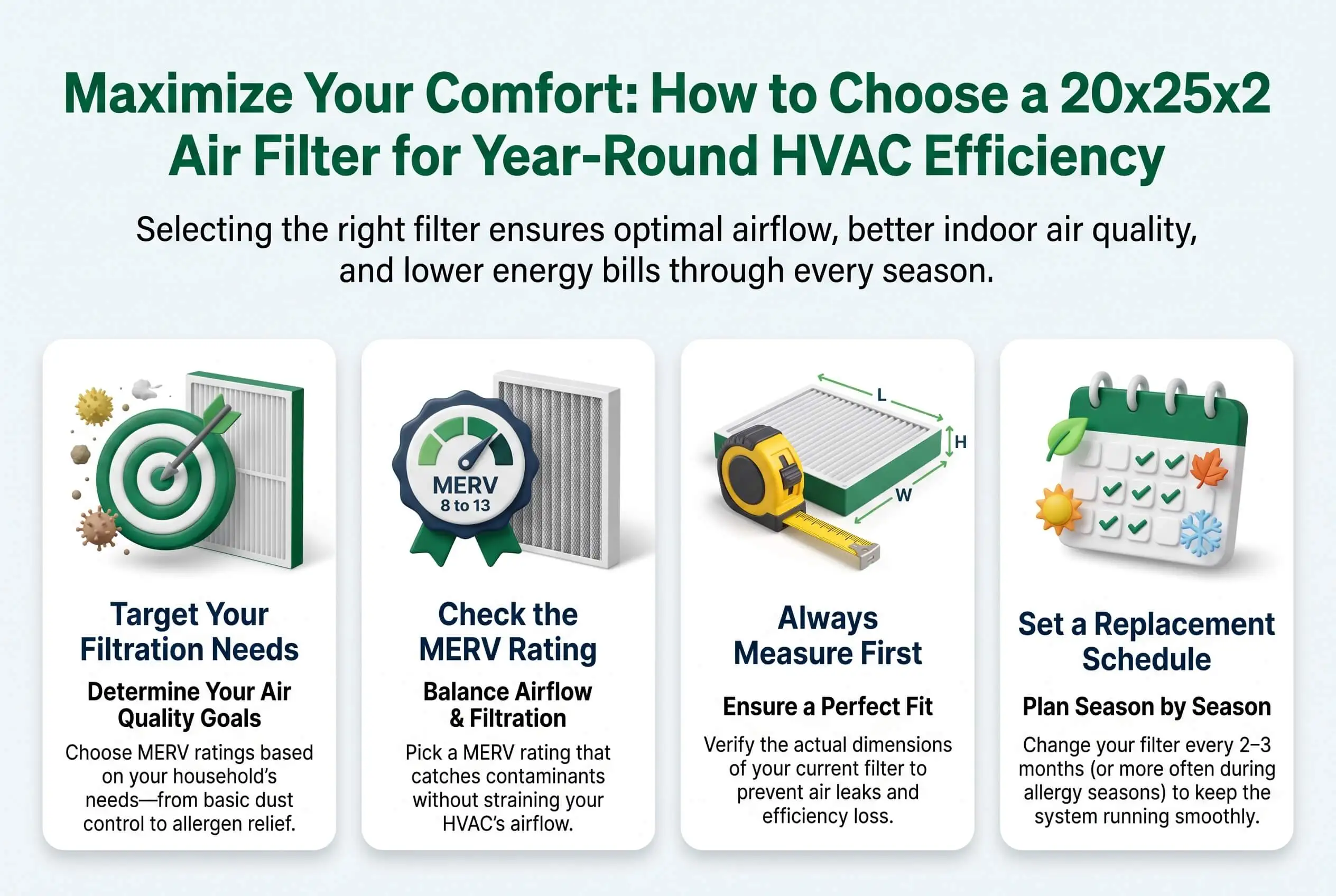
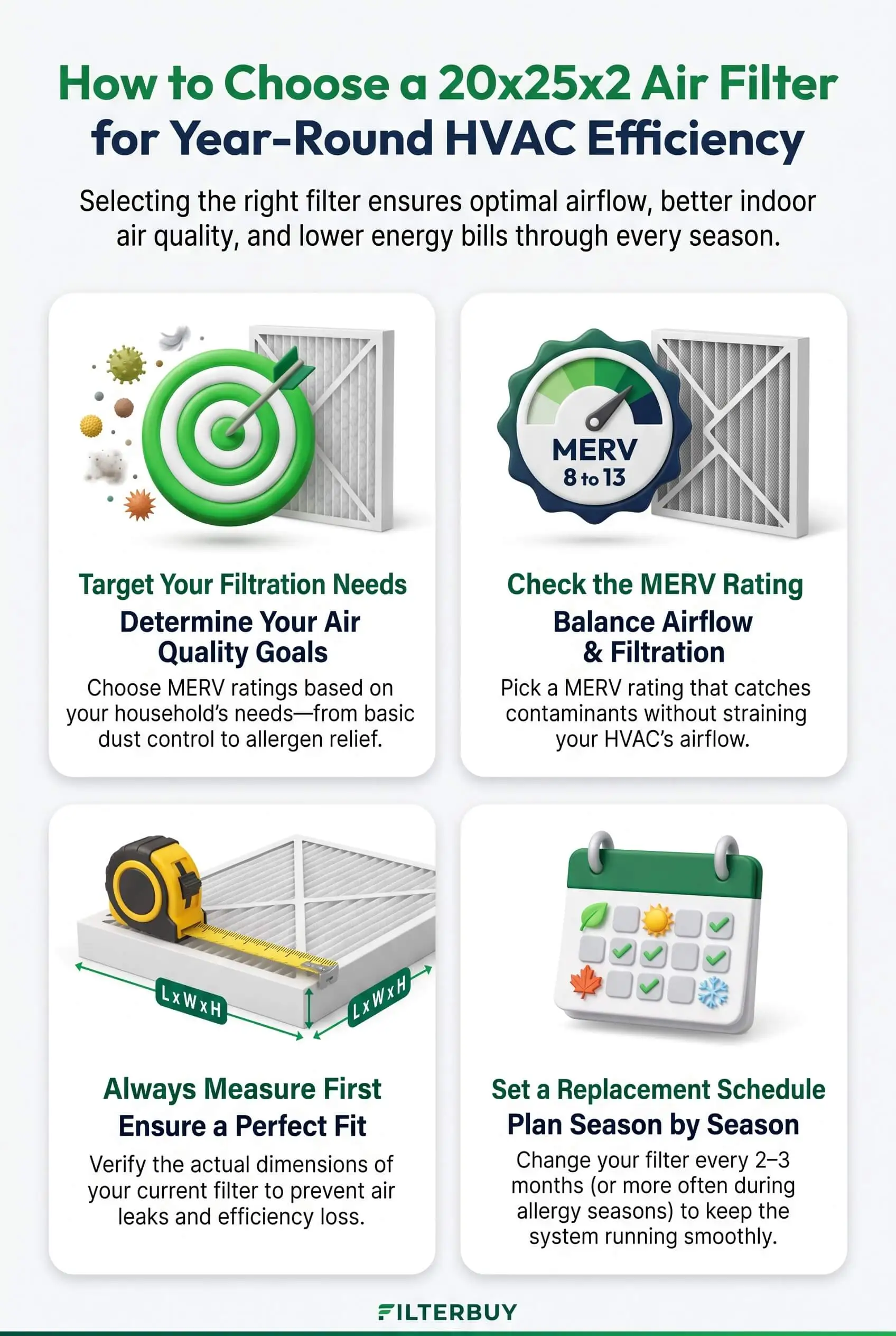
Order by name, fit by cut. A 20x25x2 actually measures 19 1⁄2 × 24 1⁄2 × 1 3⁄4 inches, and that clearance is what lets it seat properly.
Depth works in your favor. Two inches of pleated media moves air with less resistance than a one-inch filter at the same MERV.
Let your system set the MERV. MERV 8 suits most homes, 11 helps with pets and allergies, and 13 handles smoke, as long as your blower can keep up.
Think in seasons. One slot serves heating and cooling, so check it monthly through the peak months.
Stick to a schedule. Change it at least every 90 days, and sooner with pets or allergies.
What a 20x25x2 Air Filter Actually Measures
The label says 20x25x2, but that's the nominal size, the name you order by. Put a tape measure on the filter itself and it comes in a touch smaller, at 19 1⁄2 × 24 1⁄2 × 1 3⁄4 inches, so it slides into the track and sits flat.
That clearance does real work. Go any smaller and you leave gaps, and air will always take the easy path around the media instead of through it. If your old filter reads 25x20x2, you've got the same size with the numbers flipped.
Why 2-Inch Depth Helps Year-Round Efficiency
Two inches of depth packs more pleated media into the same 20 by 25 opening than a one-inch filter can hold. Air moves through all that extra surface with less resistance at the same MERV rating. The filter also takes longer to load up.
Airflow is what a central system lives on. A pleated furnace filter traps dust and airborne particles while allowing air to circulate, but as debris builds up, airflow becomes restricted. The U.S. Department of Energy says swapping a clogged filter for a clean one can cut an air conditioner's energy use by 5% to 15%.
How to Choose the Right MERV Rating for Your System
MERV stands for Minimum Efficiency Reporting Value. It tells you how well a filter catches particles between 0.3 and 10 microns, and a higher number means it traps smaller ones.
MERV 8 handles everyday dust, lint and pollen in most homes without any fuss. I'd step up to MERV 11 for a house with pets or seasonal allergies, and reach for MERV 13 when fine particles like smoke are the worry.
The EPA suggests MERV 13 filter or the highest rating your system fan and filter slot can accommodate. Before I buy, I check the furnace or air handler manual, the same way I'd double-check a size. Once I know what the system takes, I look for a 20x25x2 air filter in MERV 8, 11, or 13 in the exact cut.
A Season-by-Season Filter Plan
Your furnace and air conditioner share one blower and one filter slot, so this filter never gets a season off. That adds up fast, because the U.S. Energy Information Administration reports that heating and cooling make up more than half of a typical household's energy use. Here's how I pace it through the year:
Spring: Pollen counts climb, so I start the cooling season with a fresh filter.
Summer: The system runs hardest now, and I check the filter every month.
Fall: The first day the heat kicks on is my cue to swap it. ENERGY STAR recommends a heating check-up each fall and a cooling check-up each spring, which makes an easy reminder.
Winter: With the windows shut, dust and pet dander keep circling the house, so the monthly checks keep going.
How Often to Change a 20x25x2 Filter
Every 90 days is the baseline for most homes to avoid a dirty air filter. With a pet in the house I'd make it 60, and closer to 45 if you have several pets or someone who deals with allergies.
The light test is the quickest check I know. Hold the filter up to a lamp, and once light stops coming through the pleats, it's done. Skip the hose and the vacuum too, because water strips the electrostatic charge that helps the media grab fine particles.
Common Fit and Installation Mistakes
Pointing the arrow the wrong way. It should face toward the blower.
Dropping a one-inch filter into a two-inch track. It wobbles, and air slips around the frame.
Stacking two one-inch filters. They won't seal, so the edges leak.
Forcing in the wrong size. A bowed frame opens gaps. Measure the old filter or the slot, then round each number up to the nearest inch.
“In my years servicing air handlers, the 2-inch cabinets that run best have a filter seated tight and changed before the pleats load up, because a clean, well-sealed filter keeps static pressure low and the blower never has to fight for air. When a homeowner tells me the system feels weaker every August, the filter is the first thing I pull, and it’s usually gray from edge to edge.”
7 Essential Resources
20x25x2 Air Filters. Exact-cut 20x25x2 filters in MERV 8, 11 and 13.
What Is a MERV Rating?. The EPA walks through MERV in plain language, rating by rating and particle size by particle size.
Heating and Cooling Maintenance Checklist. ENERGY STAR's seasonal check-up list, monthly filter checks included.
Air Filters for Allergies. Allergists explain whole-house filtration and why they point people toward MERV 11 to 13.
Understanding MERV and Filtration Publications. The National Air Filtration Association's user guides on ASHRAE Standard 52.2.
Understanding MERV User's Guide. The Department of Energy's Building America library entry on how MERV testing works.
Air-Cleaning Devices. North Carolina's public health team covers HVAC filters and air cleaners for homeowners.
3 Statistics
5% to 15%. That's how much a clean filter in place of a dirty, clogged one can trim from an air conditioner's energy use. Source: U.S. Department of Energy
52%. Space heating and air conditioning took this share of a U.S. household's annual energy use in 2020. Source: U.S. Energy Information Administration
106 million. More than this many people in the U.S. deal with allergies each year, roughly 1 in 3. Source: Asthma and Allergy Foundation of America
With heating and cooling accounting for 52% of household energy use, choosing the top air filters and replacing them regularly can make a difference. A clean filter can reduce an air conditioner's energy use by 5% to 15%, while effective filtration also matters for the more than 106 million Americans who experience allergies each year.
Final Thoughts and Opinion
I think the 20x25x2 is one of the most overlooked parts of a home's comfort system. It works just as hard in July as it does in January, and anything that runs all year deserves a plan instead of a guess.
Keep it simple. Confirm the exact cut, choose the highest MERV your system can handle and tie your filter checks to the seasons. Those habits protect the airflow your system's efficiency depends on. While an air purifier can help clean the air in individual rooms, your HVAC filter helps manage airborne particles throughout the home. It's a little effort for a big impact, and it puts you firmly in charge of the air your family breathes.
Frequently Asked Questions
Is a 20x25x2 air filter the same as a 25x20x2?
Yes. Manufacturers list length and width in either order, so both labels point to the same filter.
Can I use a 20x25x1 filter in a 20x25x2 slot?
Not reliably. A one-inch filter has roughly an inch of wiggle room in a two-inch track, so it shifts around and air sneaks past the media.
Does a higher MERV filter hurt HVAC efficiency?
It can, if your system wasn't designed for it. Denser media adds resistance, so check your manual and go with the highest rating your blower and filter slot can handle.
How often should I change a 20x25x2 filter in summer versus winter?
The 90-day baseline holds in both seasons, but I check monthly whenever the heat or AC runs hard. If light won't pass through the pleats, replace it, whatever the calendar says.
Does one 20x25x2 filter cover both the furnace and the air conditioner?
Yes, in a central system. Your heating and cooling run through the same blower and the same filter slot.
Can I wash and reuse a pleated 20x25x2 filter?
No. Washing strips the electrostatic charge from the media, and a rinsed filter won't catch fine particles the way a new one does.
Choose Your 20x25x2 Air Filter With Confidence
The right 20x25x2 air filter for year-round HVAC efficiency starts with the exact cut and a MERV rating your system can handle. Measure your slot, check your manual and set a seasonal reminder, and your system will breathe easily all year.