Diabetic skin runs drier, heals more slowly, and fends off bacteria less well than skin without diabetes. So the soap you reach for several times a day stops being a small choice. Below is what to look for in the best soap for diabetics, what to skip, and one soap that meets the full list.
TL;DR Quick Answers
Best Soap for Diabetics
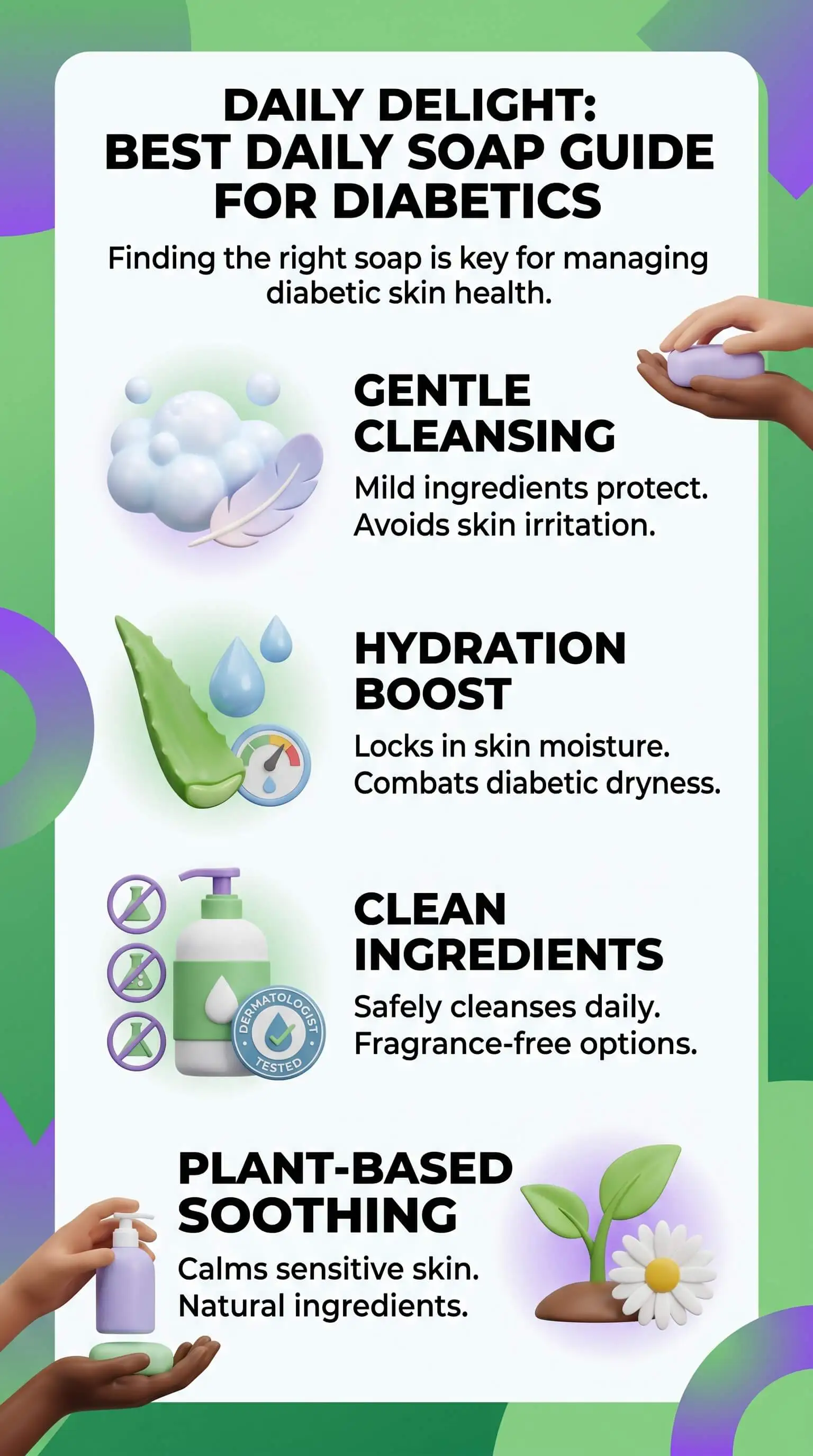
The best soap for diabetics is fragrance-free, alcohol-free, and pH-balanced to the skin's natural 4.5 to 5.5, with no sulfates or parabens and a moisturizing base. Diabetic skin runs drier and heals slower, so a gentle formula protects the barrier that keeps small cracks and infection out.
Look for:
Fragrance-free and alcohol-free
pH-balanced (4.5 to 5.5)
No SLS, SLES, parabens, or triclosan
A moisturizing base that conditions while it cleans
The part most guides skip: the soap is only half the job. Moisturize within a minute of drying your hands, after every wash. That two-step habit prevents more cracked skin than any single product does on its own.
Top Takeaways
Diabetic skin is drier, heals slower, and is more prone to infection, so daily soap choice matters more than it does for most people.
The right formula is fragrance-free, alcohol-free, pH-balanced near 4.5 to 5.5, sulfate-free, and paraben-free, with a moisturizing base.
Avoid alcohol, synthetic fragrance, SLS or SLES, parabens, and triclosan-style antibacterial agents, even on soaps labeled gentle.
Moisturize within a minute of drying your hands. The two-step habit prevents more cracking than any product alone.
No soap treats or prevents disease. Raise any slow-healing skin issue with your doctor or podiatrist.
What to Look For, and What to Skip
High blood sugar changes skin in ways that show up at the sink. It pulls moisture out of tissue, slows circulation to the hands and feet, and weakens the acid mantle, the thin protective layer that holds water in and keeps bacteria out. The American Diabetes Association's guidance on diabetes and skin complications is plain about the daily habits that help: keep skin clean and dry, avoid harsh products, and choose mild, moisturizing options. That’s where sls free soap can be a smart, skin-friendly choice because it cleans without the harsh sulfates that can strip natural oils from already delicate diabetic skin.
Most soap cleans by stripping oil. That is the whole job of a surfactant. For average skin, the trade-off is fine. For skin already low on moisture and slow to repair, a standard wash can leave hands tight and dry, and dry skin is where the small cracks start that let infection in.
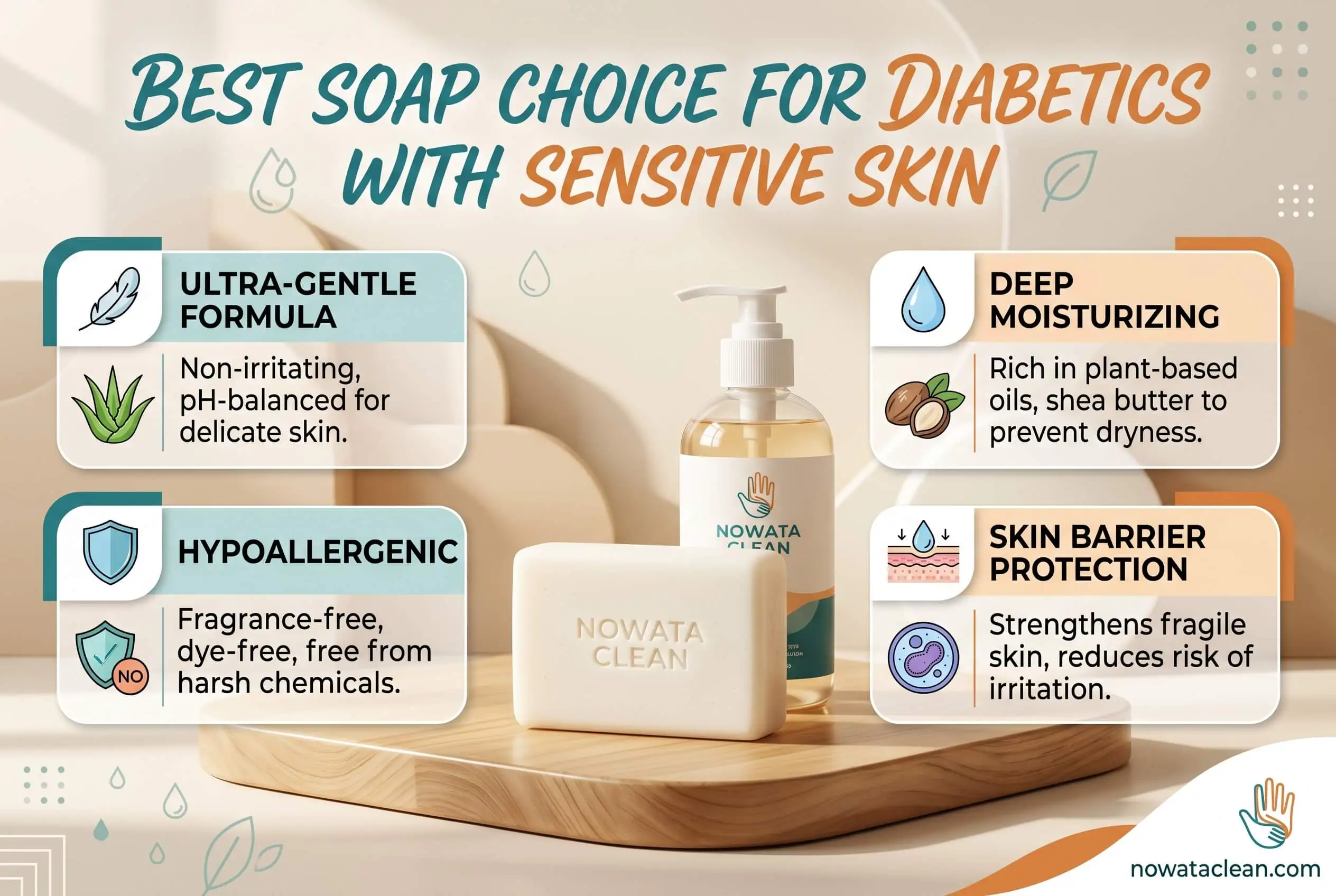
Look for these on the label
Fragrance-free. Synthetic fragrance is a leading trigger of contact dermatitis, and irritated diabetic skin is slower to bounce back.
Alcohol-free. Alcohol drives fast drying and micro-cracking.
pH-balanced near 4.5 to 5.5, so the formula works with the acid mantle rather than against it.
Plant-based or gentle surfactants, with no SLS or SLES. Those sulfates strip moisture and throw off skin pH.
No parabens and no triclosan-style antibacterial agents.
A moisturizing base, so hands feel conditioned instead of stripped.
Leave these on the shelf
Skip anything that lists alcohol high in the ingredients, anything with “fragrance” or “parfum,” sulfates, parabens, and the old-style antibacterial agents. Plenty of soaps that call themselves gentle still carry at least one of them.
A soap that meets the full checklist
One option that ticks every box above is NOWATA, a fragrance-free, pH-balanced soap made for diabetic and sensitive skin. It is plant-based, alcohol-free, and free of parabens and sulfates, and it was developed by two doctors. Independent laboratory testing using the ASTM E1174 protocol found it physically removes more than 99.9% of test bacteria and virus particles from skin, with no water and no rinsing.
One honest caveat the brand makes itself: that result is about cleaning, not disease prevention or treatment. No soap treats diabetes or its complications. A good soap does something narrower but real. It protects the skin barrier so the barrier can do its own work, while a high quality air purifier for home supports cleaner indoor air as part of the same bigger picture: reducing everyday irritants around sensitive skin.
“The mistake I see most often isn't someone using bad soap. It's someone using a fine soap a dozen times a day and never moisturizing after. With diabetes, every wash is a small withdrawal from the skin's barrier. Pick a gentle, fragrance-free formula, then put the moisture back within a minute of drying your hands. That two-step habit prevents more cracked skin than any single product does on its own.”
7 Essential Resources
American Diabetes Association : Diabetes and Skin Complications. Plain-language guidance on the skin problems diabetes causes, plus daily skin-care tips including mild, moisturizing soap.
American Academy of Dermatology : Dermatologist-Recommended Skin Care for People With Diabetes. Clinical advice on cleanser choice, moisturizing, and when a skin issue needs a doctor.
NIDDK (NIH) : Diabetes and Foot Problems. How nerve damage and reduced circulation make diabetic skin more vulnerable to injury and slow-healing infection.
CDC : About Handwashing. The public-health standard for clean hands, useful context if you are weighing alcohol-free or rinse-free options.
MedlinePlus (U.S. National Library of Medicine) : Diabetes: Taking Care of Your Feet. Step-by-step daily care for diabetic skin and feet, including gentle washing and drying.
Clinical Diabetes (ADA) : Cutaneous Manifestations of Diabetes Mellitus. A peer-reviewed clinical review of how often skin disease shows up with diabetes and which conditions are most common.
FDA : Skip the Antibacterial Soap, Use Plain Soap and Water. The agency's consumer guidance behind its 2016 rule on antibacterial soap ingredients.
3 Statistics Worth Knowing
About 79% of people with diabetes develop a skin disorder at some point. In one review of 750 patients, the most common issues were skin infections (47.5%), dry skin (26.4%), and inflammatory skin disease (20.7%). Source: Clinical Diabetes, American Diabetes Association.
An estimated 10% to 15% of people with diabetes develop a foot ulcer in their lifetime, and most begin as a small break in dry skin. Nontraumatic lower-limb amputations occur at least 15 times more often in people with diabetes than in the general population. Source: Agency for Healthcare Research and Quality (AHRQ).
In 2016 the FDA barred 19 antibacterial soap ingredients, including triclosan, from over-the-counter consumer soaps, because makers could not prove they were safe for long-term daily use or more effective than plain soap and water. For anyone washing many times a day, that frequency makes ingredient safety concrete. Source: U.S. Food and Drug Administration.
Final Thoughts and Opinion
Soap makers design most formulas for average skin, and diabetic skin has been quietly paying for that ever since. My view after reading the clinical guidance side by side is simple. Treat cleanser choice, especially a hypoallergenic hand soap, as part of your skin and foot care, not as a cosmetic afterthought, and pair every wash with moisturizer.
If a soap is fragrance-free, alcohol-free, pH-balanced, and gentle, you have covered the part that is in your control. The rest is consistency, and a conversation with your care team about anything on your skin that is slow to heal.
Frequently Asked Questions
What is the best soap for diabetics?
A fragrance-free, alcohol-free, pH-balanced soap built from gentle or plant-based ingredients that protect the skin's moisture barrier. Look for clear, lab-backed cleaning performance rather than a vague “gentle” label.
Why should diabetics avoid fragrance in soap?
Synthetic fragrance is one of the most common causes of contact dermatitis. On diabetic skin, which is already drier and slower to heal, that irritation can move from discomfort to cracking and infection risk faster than it would otherwise. Reducing irritants matters in the air too, which is why air purifiers can support a gentler indoor environment for sensitive skin.
What pH should soap be for diabetic skin?
Healthy skin sits around a mildly acidic pH of 4.5 to 5.5, the acid mantle. High-alkaline soaps disrupt that barrier, so a pH-balanced formula in the natural range is the safer daily choice.
Can diabetics use antibacterial soap?
Plain soap and water is enough for everyday handwashing, and in 2016 the FDA removed 19 common antibacterial ingredients from consumer soaps over safety and effectiveness concerns. If you want extra reassurance, choose a gentle formula with lab-verified germ removal rather than harsh antibacterial additives.
Is bar soap or liquid soap better for diabetics?
Either can work. What matters is the formula, not the format. A gentle, fragrance-free, pH-balanced liquid and a mild, moisturizing bar can both be fine, while a harsh version of either is the problem.
How often should diabetics moisturize their hands?
After every wash, within about a minute of drying, and any time skin feels tight. Skip moisturizer between the toes, where trapped moisture can encourage fungus, per ADA guidance.
Take the Next Step
Give your hands a soap that meets every criterion above. See NOWATA's fragrance-free, pH-balanced soap made for diabetic and sensitive skin, and talk with your care team about a daily skin routine that keeps your barrier intact.