In a dry climate, a standard air filter moves particles through the filtration cycle at a predictable rate. Southern homes push past that assumption. When indoor humidity regularly climbs above 60 percent, moisture reaches the filter media before the particle load does. Fibers clump together, airflow resistance builds, and a filter rated for 90 days can wear out in 30. That's a climate reality most packaging doesn't account for, and most homeowners don't catch it until they're already paying for it in energy bills and degraded indoor air.
TL;DR Quick Answers
air filters
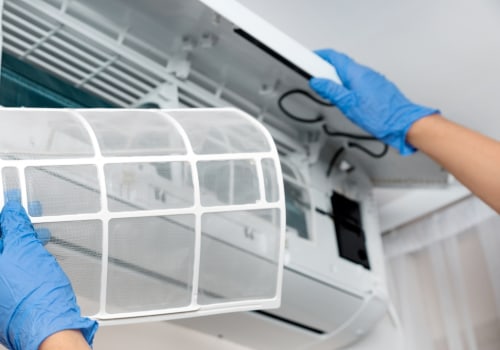
Air filters are devices installed in HVAC systems that capture airborne particles — dust, pollen, mold spores, pet dander, and biological debris — before they circulate through your home. The filter sits in the return air path and traps those particles in a fibrous or pleated media layer as air moves through the system.
The filter rating that matters most is MERV (Minimum Efficiency Reporting Value), defined by ASHRAE Standard 52.2. The scale runs from 1 to 16. Higher ratings capture finer particles. For most homes, MERV 8 is the practical minimum. MERV 11 is the better choice for households with pets, allergies, or high indoor humidity.
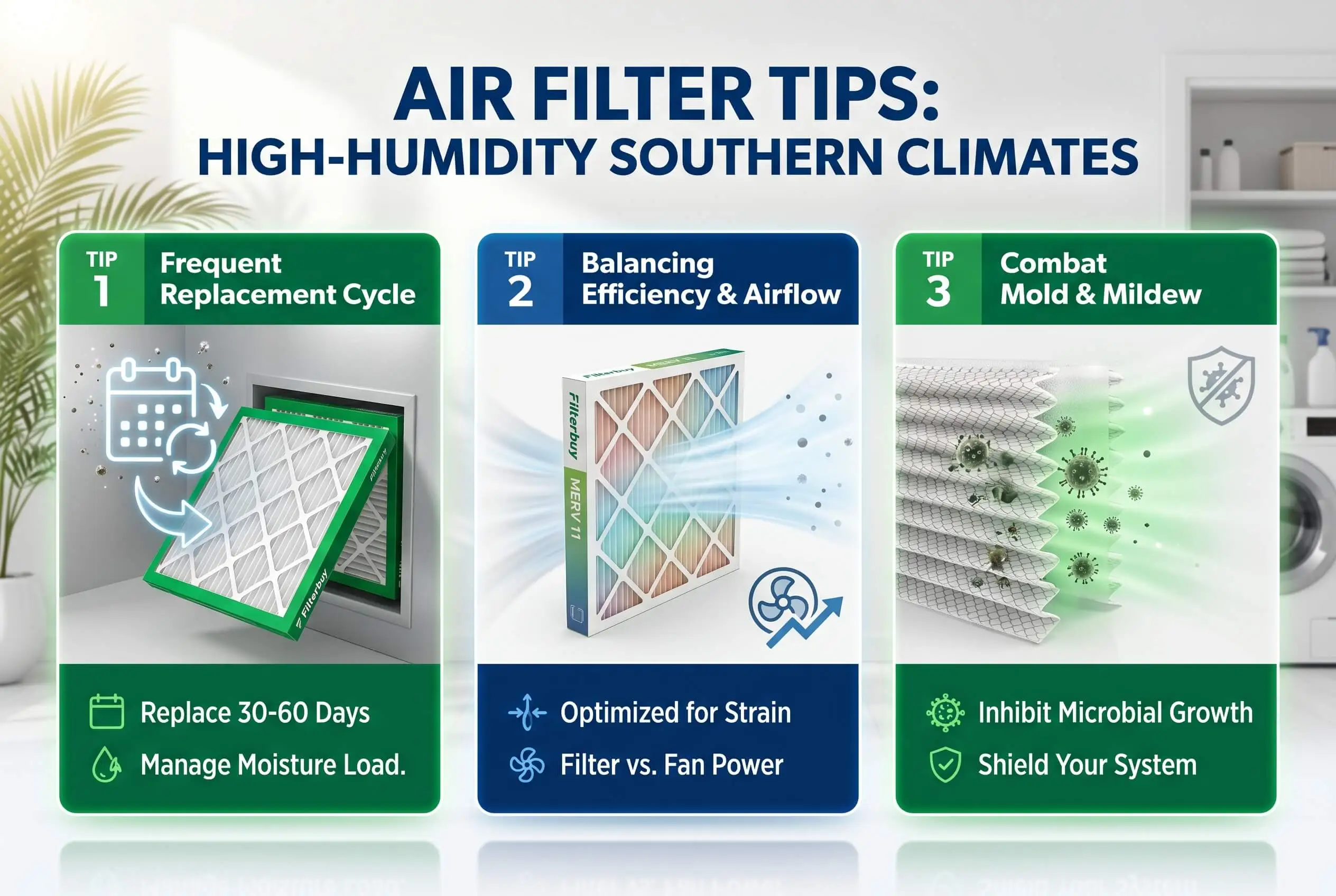
Replace standard 1-inch filters every 30 to 90 days depending on your climate, home conditions, and how often your system runs. Humid Southern climates load filters with moisture faster than dry-climate replacement schedules account for — plan on 30 to 45 days during peak season, not the standard 60 to 90.
A clogged filter restricts airflow, forces your HVAC system to work harder, and can allow biological contaminants to pass through or grow on the media itself. Replacing air filters on schedule protects your indoor air, your HVAC equipment, and your energy bill.
Top Takeaways
In humid Southern climates, filter media absorbs moisture and restricts airflow faster than standard replacement schedules assume — plan on 30 to 45 days, not the usual 60 to 90.
We recommend MERV 8 for most humid Southern homes: it captures fine mold fragments and biological particles without overtaxing standard residential HVAC equipment.
A saturated filter can become a contamination source rather than a barrier, which is why timely replacement matters for indoor air quality and HVAC efficiency equally.
Indoor relative humidity above 60 percent accelerates both mold and dust mite growth, which degrades respiratory health and speeds up filter loading at the same time.
Charged-media filters often lose electrostatic efficiency faster in humid conditions.
A genuine pleated filter holds its performance longer in moist operating air.
The Department of Energy has found that a clean filter can lower AC energy consumption by 5 to 15 percent, which means the right replacement schedule is a financial call as much as a health one.
Why Humid Southern Climates Demand a Different Approach to Air Filters
How Humidity Affects Filter Media
That process works when incoming air is reasonably dry. In Southern climates, it often isn't. When outdoor humidity pushes past 70 percent and HVAC systems run most of the day, return air carries moisture that saturates filter media well before the particle load becomes the issue.
Home air filters play an important role in protecting indoor air quality by helping manage moisture-related particle buildup and supporting healthier airflow through the system. When they stay dry and are replaced on time, they help air move more efficiently, reduce strain on the HVAC system, and keep captured contaminants from becoming a larger indoor air concern.
MERV Rating Guidance for High-Humidity Homes
MERV (Minimum Efficiency Reporting Value) is the standard scale for air filter efficiency, defined by ASHRAE Standard 52.2. The scale runs from 1 to 16, with higher ratings capturing progressively finer particles. For most Southern homes, MERV 8 is the practical floor: it captures pollen, dust mites, mold spores, and basic household debris.
MERV 11 is where most humid-climate homeowners notice a real difference. It captures particles down to 1.0 micron — fine mold fragments, pet dander, and a broader range of airborne biological material — without the airflow restriction that higher-MERV filters impose on older residential equipment.
MERV ratings are tested under dry laboratory conditions, and that context matters in the South. Charged-media filters (which rely on static electricity rather than mechanical filtration) often lose efficiency faster than their rated value when operating in humid air. A genuine MERV 11 pleated or fiberglass filter holds its performance longer, which is why we specify media type alongside MERV rating when making recommendations for humid-climate homes.
How Often to Change Your Air Filter in a Humid Climate
Standard manufacturer guidance puts replacement at every 60 to 90 days — an interval built around temperate conditions where systems run a fraction of the day and incoming air is reasonably dry.
Neither assumption holds in Florida or along the Gulf Coast in summer. Systems run 12 or more hours daily, and the return air they're pulling is significantly more moisture-laden than a dry-climate system encounters. A filter rated for 60 days in those baseline conditions can reach capacity in 30 to 45 days here. Homes with pets, allergy sufferers, or older ductwork should plan toward the shorter end of that window and watch for early warning signs rather than waiting for the calendar.
Signs Your Filter Is Failing in a Humid Home
Most of the time, you'll notice something is wrong before you think to check the filter. Watch for these:
Noticeably weaker airflow from supply vents, even when the system runs at normal settings
A musty or earthy smell that returns within days of cleaning, which points to mold spores passing through or colonizing the media
Dark patches or unusual discoloration on a filter that was installed recently
Rising energy bills with no change in thermostat settings or household activity
"Gulf Coast returns look different from what comes back out of dry markets — you can tell immediately when you pick them up. The media carries more weight, moisture weight, and when you hold one up to the light, the fiber density has already shifted before the particle load's had a chance to catch up. That's what tells us the replacement clock runs faster in the South than the packaging says."
Noticeably weaker airflow from supply vents, even when the system runs at normal settings
A musty or earthy smell that returns within days of cleaning, which points to mold spores passing through or colonizing the media
Dark patches or unusual discoloration on a filter that was installed recently
Rising energy bills with no change in thermostat settings or household activity
"Gulf Coast returns look different from what comes back out of dry markets — you can tell immediately when you pick them up. The media carries more weight, moisture weight, and when you hold one up to the light, the fiber density has already shifted before the particle load's had a chance to catch up. That's what tells us the replacement clock runs faster in the South than the packaging says."
7 Essential Resources
How Biological Contaminants Travel Through Your HVAC System
When indoor relative humidity stays above 60 percent, mold, dust mites, and bacteria can reproduce, and your HVAC system becomes the distribution network. The EPA's guide on biological pollutants traces exactly how that cycle runs in residential settings and why filtration is only one part of managing it.
Source: https://www.epa.gov/indoor-air-quality-iaq/biological-pollutants-impact-indoor-air-quality
When indoor relative humidity stays above 60 percent, mold, dust mites, and bacteria can reproduce, and your HVAC system becomes the distribution network. The EPA's guide on biological pollutants traces exactly how that cycle runs in residential settings and why filtration is only one part of managing it.
Source: https://www.epa.gov/indoor-air-quality-iaq/biological-pollutants-impact-indoor-air-quality
What the CDC Wants Homeowners to Know About Mold and Indoor Environments
Mold enters homes through open doors, windows, and HVAC systems, and grows wherever moisture lands on a surface that can sustain it. The CDC's mold resource covers the health effects for different populations (including those with asthma or mold allergies) and the specific steps that interrupt the growth cycle in a home.
Mold enters homes through open doors, windows, and HVAC systems, and grows wherever moisture lands on a surface that can sustain it. The CDC's mold resource covers the health effects for different populations (including those with asthma or mold allergies) and the specific steps that interrupt the growth cycle in a home.
ASHRAE on Filtration Standards and What MERV Ratings Actually Measure
MERV ratings are defined by ASHRAE Standard 52.2, which tests filter efficiency against particles from 0.3 to 10 microns under controlled conditions. ASHRAE's filtration resource explains how those ratings translate to real-world HVAC performance and why pushing to a higher MERV number can backfire if your system wasn't built for the airflow resistance it creates.
Source: https://www.ashrae.org/technical-resources/filtration-and-disinfection-faq
MERV ratings are defined by ASHRAE Standard 52.2, which tests filter efficiency against particles from 0.3 to 10 microns under controlled conditions. ASHRAE's filtration resource explains how those ratings translate to real-world HVAC performance and why pushing to a higher MERV number can backfire if your system wasn't built for the airflow resistance it creates.
Source: https://www.ashrae.org/technical-resources/filtration-and-disinfection-faq
The U.S. Department of Energy on Why Filter Maintenance Is an Energy Issue
A moisture-overloaded filter costs money and air quality, not just one or the other. The Department of Energy's guidance on air conditioner maintenance shows what restricted airflow does to system efficiency and why that impacts compounds for Southern HVAC systems running near-continuously for months at a stretch.
Source: https://www.energy.gov/energysaver/maintaining-your-air-conditioner
A moisture-overloaded filter costs money and air quality, not just one or the other. The Department of Energy's guidance on air conditioner maintenance shows what restricted airflow does to system efficiency and why that impacts compounds for Southern HVAC systems running near-continuously for months at a stretch.
Source: https://www.energy.gov/energysaver/maintaining-your-air-conditioner
The Florida Department of Health Indoor Air Program
Biological pollutants are the most prevalent indoor air concern in Florida homes, an unsurprising designation for a state where outdoor humidity routinely stays elevated year-round. The Florida Department of Health has run an Indoor Air Program since the late 1980s, providing guidance to residents, schools, and healthcare facilities navigating exactly these conditions.
Source: https://www.floridahealth.gov/environmental-health/indoor-air-quality/index.html
Biological pollutants are the most prevalent indoor air concern in Florida homes, an unsurprising designation for a state where outdoor humidity routinely stays elevated year-round. The Florida Department of Health has run an Indoor Air Program since the late 1980s, providing guidance to residents, schools, and healthcare facilities navigating exactly these conditions.
Source: https://www.floridahealth.gov/environmental-health/indoor-air-quality/index.html
The American Lung Association on Moisture, Mold, and Respiratory Risk
The American Lung Association connects indoor moisture directly to respiratory health outcomes, covering the mold exposure effects for people with asthma and allergies as well as the moisture entry points most common in Southern homes: AC unit condensation, inadequate bathroom ventilation, and improper dryer venting. Your air filter works against all of those simultaneously.
Source: https://www.lung.org/clean-air/indoor-air/indoor-air-pollutants/mold
The American Lung Association connects indoor moisture directly to respiratory health outcomes, covering the mold exposure effects for people with asthma and allergies as well as the moisture entry points most common in Southern homes: AC unit condensation, inadequate bathroom ventilation, and improper dryer venting. Your air filter works against all of those simultaneously.
Source: https://www.lung.org/clean-air/indoor-air/indoor-air-pollutants/mold
NIEHS Research on Rising Indoor Air Pollutant Concentrations
Research from the National Institute of Environmental Health Sciences links rising indoor pollutant concentrations directly to hotter temperatures and higher humidity. For homeowners in Florida, Louisiana, and Alabama, those aren't future projections. They're current baseline conditions, and every delay in filter maintenance compounds in climates where the pressure on indoor air quality never really lets up.
Source: https://www.niehs.nih.gov/health/topics/agents/indoor-air
Research from the National Institute of Environmental Health Sciences links rising indoor pollutant concentrations directly to hotter temperatures and higher humidity. For homeowners in Florida, Louisiana, and Alabama, those aren't future projections. They're current baseline conditions, and every delay in filter maintenance compounds in climates where the pressure on indoor air quality never really lets up.
Source: https://www.niehs.nih.gov/health/topics/agents/indoor-air
3 Supporting Statistics
The EPA Humidity Threshold Most Southern Homes Are Already Pushing Against
Shipping to South Florida, the Gulf Coast, and the Carolinas, we hear consistently from homeowners who are surprised to find their indoor humidity is already outside the safe zone. The outdoor air feeding their systems is carrying that load, not anything they've done wrong. The EPA recommends keeping indoor relative humidity between 30 and 50 percent to control moisture-related biological growth. For Southern homeowners, hitting that range means actively managing it with the help of an air purifier, not assuming the HVAC system is handling it on its own.
Source: https://www.epa.gov/indoor-air-quality-iaq/improving-your-indoor-environment
Shipping to South Florida, the Gulf Coast, and the Carolinas, we hear consistently from homeowners who are surprised to find their indoor humidity is already outside the safe zone. The outdoor air feeding their systems is carrying that load, not anything they've done wrong. The EPA recommends keeping indoor relative humidity between 30 and 50 percent to control moisture-related biological growth. For Southern homeowners, hitting that range means actively managing it with the help of an air purifier, not assuming the HVAC system is handling it on its own.
Source: https://www.epa.gov/indoor-air-quality-iaq/improving-your-indoor-environment
The Real Energy Cost of Running a Filter Past Its Useful Life
Customers who stick to a dry-climate replacement schedule often run their systems harder than they realize. The Department of Energy has found that switching a dirty, clogged filter for a clean one can lower an air conditioner's energy consumption by 5 to 15 percent. In a Southern home where the system runs nearly year-round, that 5 to 15 percent shows up on monthly utility bills consistently, not just seasonally.
Source: https://www.energy.gov/energysaver/air-conditioner-maintenance
Customers who stick to a dry-climate replacement schedule often run their systems harder than they realize. The Department of Energy has found that switching a dirty, clogged filter for a clean one can lower an air conditioner's energy consumption by 5 to 15 percent. In a Southern home where the system runs nearly year-round, that 5 to 15 percent shows up on monthly utility bills consistently, not just seasonally.
Source: https://www.energy.gov/energysaver/air-conditioner-maintenance
What Research Shows About Humidity Thresholds for Mold and Dust Mite Growth
A peer-reviewed study published in Environmental Health Perspectives found that most fungal species can't grow unless indoor relative humidity exceeds 60 percent, and that dust mite populations peak at 80 percent relative humidity. [VERIFY] For a Southern home where outdoor air regularly hits 70 to 80 percent humidity in summer, the pressure on indoor humidity control — and on the filter absorbing that load — is constant.
Source: https://ehp.niehs.nih.gov/doi/10.1289/ehp.8665351
A peer-reviewed study published in Environmental Health Perspectives found that most fungal species can't grow unless indoor relative humidity exceeds 60 percent, and that dust mite populations peak at 80 percent relative humidity. [VERIFY] For a Southern home where outdoor air regularly hits 70 to 80 percent humidity in summer, the pressure on indoor humidity control — and on the filter absorbing that load — is constant.
Source: https://ehp.niehs.nih.gov/doi/10.1289/ehp.8665351
Final Thoughts and Opinion
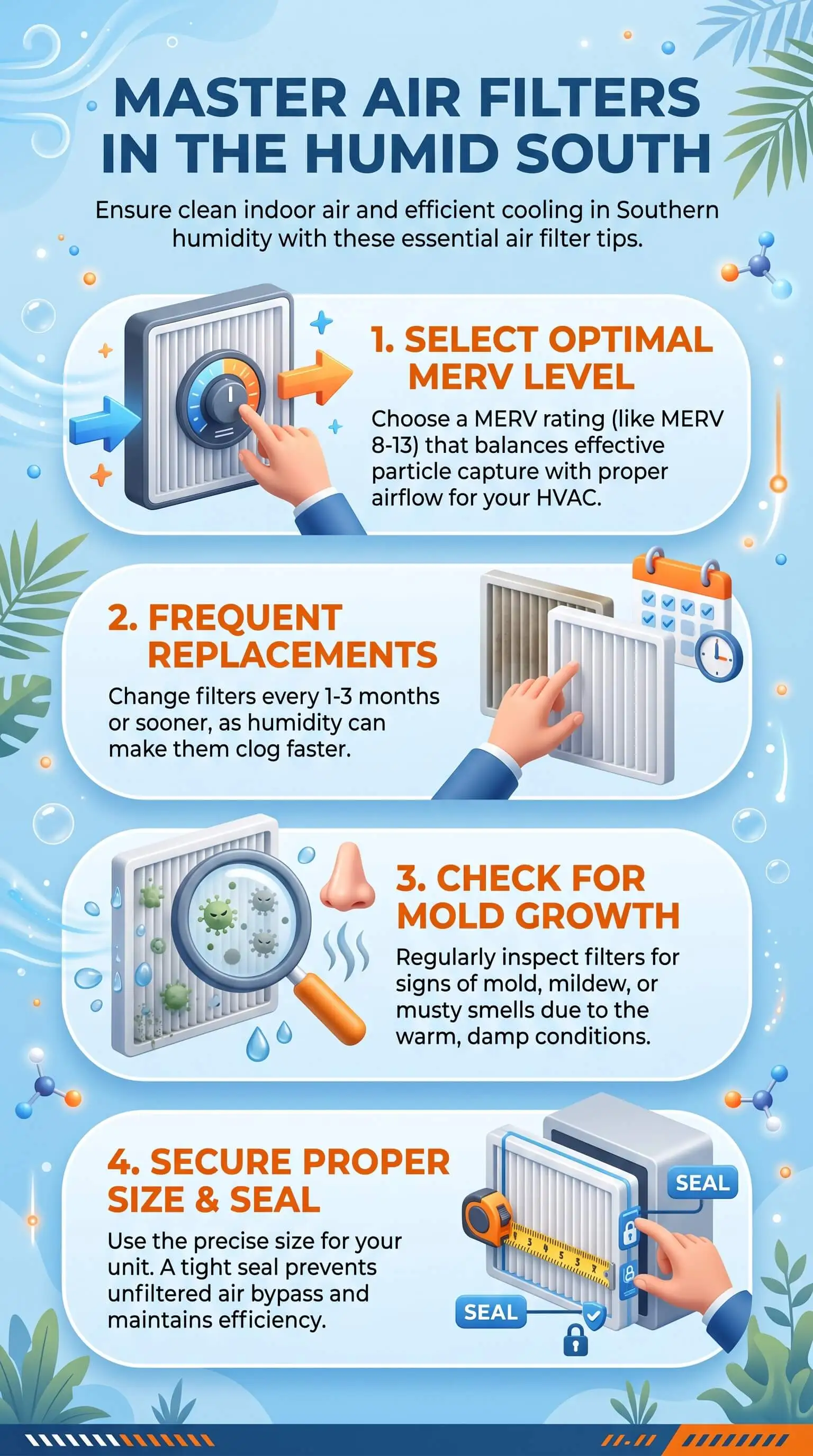
A MERV 11 filter on a 30- to 45-day schedule is, in our view, the most practical combination for Southern homes running their systems year-round. It's a mid-range option that fits how these systems actually operate: continuously, against incoming air carrying far more moisture than the national averages most manufacturer guidance is built around.
What most homeowners underestimate is how the compounding works when nothing changes. A filter running saturated strains the system and lets biological material circulate rather than capturing it, while energy bills climb quietly in the background. None of that announces itself loudly. It builds gradually, which is exactly what makes the right filter rating and the right replacement schedule worth getting right before the season hits.
A MERV 11 filter on a 30- to 45-day schedule is, in our view, the most practical combination for Southern homes running their systems year-round. It's a mid-range option that fits how these systems actually operate: continuously, against incoming air carrying far more moisture than the national averages most manufacturer guidance is built around.
What most homeowners underestimate is how the compounding works when nothing changes. A filter running saturated strains the system and lets biological material circulate rather than capturing it, while energy bills climb quietly in the background. None of that announces itself loudly. It builds gradually, which is exactly what makes the right filter rating and the right replacement schedule worth getting right before the season hits.
Frequently Asked Questions
Q: What MERV rating is best for a home in a humid Southern climate?
A: We recommend MERV 11 for most Southern homes. It hits the right balance between particle capture and airflow for systems running frequently against moisture-loaded return air:
MERV 8 is the acceptable floor: it captures pollen, basic mold spores, and dust mites in a humid climate but leaves finer biological particles uncaptured
MERV 11 adds fine mold fragments, a broader range of biological particles, and finer pet dander capture without restricting airflow in most residential systems
MERV 13 and above can restrict airflow in older equipment and should only be used if your system is specifically rated for the higher resistance
A: We recommend MERV 11 for most Southern homes. It hits the right balance between particle capture and airflow for systems running frequently against moisture-loaded return air:
MERV 8 is the acceptable floor: it captures pollen, basic mold spores, and dust mites in a humid climate but leaves finer biological particles uncaptured
MERV 11 adds fine mold fragments, a broader range of biological particles, and finer pet dander capture without restricting airflow in most residential systems
MERV 13 and above can restrict airflow in older equipment and should only be used if your system is specifically rated for the higher resistance
Q: How often should I change my air filter in Florida or the Gulf Coast region?
A: Plan on every 30 to 45 days during summer and high-humidity months, not the 60 to 90 days that make sense in drier climates. Factors that shorten that window further include:
Homes with pets (additional dander and hair load on the filter media)
Allergy or asthma sufferers in the household
Older ductwork with gaps that pull in additional particulates
Systems running more than 12 hours daily during peak cooling season
A: Plan on every 30 to 45 days during summer and high-humidity months, not the 60 to 90 days that make sense in drier climates. Factors that shorten that window further include:
Homes with pets (additional dander and hair load on the filter media)
Allergy or asthma sufferers in the household
Older ductwork with gaps that pull in additional particulates
Systems running more than 12 hours daily during peak cooling season
Q: Can high humidity cause mold to grow on my air filter?
A: Yes. When filter media absorbs enough moisture, it can develop surface conditions where mold spores the filter has already captured begin growing rather than staying inert. A visibly dark or discolored filter, even one installed recently, warrants immediate replacement in a humid climate. A mold-colonized filter distributes spores into your living space rather than capturing them.
A: Yes. When filter media absorbs enough moisture, it can develop surface conditions where mold spores the filter has already captured begin growing rather than staying inert. A visibly dark or discolored filter, even one installed recently, warrants immediate replacement in a humid climate. A mold-colonized filter distributes spores into your living space rather than capturing them.
Q: Does humidity affect how well air filters clean the air?
A: Humidity affects filter performance in two ways. Moisture causes filter fibers to clump, which increases airflow resistance and reduces how much air the system processes per cycle. Charged-media filters also lose their electrostatic efficiency faster in humid conditions, reducing particle capture even before the filter appears visually loaded. Both effects mean you're getting less clean air per hour from the same filter than you would in a dry climate.
A: Humidity affects filter performance in two ways. Moisture causes filter fibers to clump, which increases airflow resistance and reduces how much air the system processes per cycle. Charged-media filters also lose their electrostatic efficiency faster in humid conditions, reducing particle capture even before the filter appears visually loaded. Both effects mean you're getting less clean air per hour from the same filter than you would in a dry climate.
Q: What are the signs that my air filter is overloaded with moisture?
A: Five signs tell you to act before the scheduled date:
Noticeably weaker airflow from supply vents despite the system running at normal settings
A musty or earthy smell that returns quickly after cleaning
Visible dark or wet-looking patches on a recently installed filter
Increased energy bills with no change in thermostat settings or household activity
Allergy or respiratory symptoms that worsen indoors even when outdoor conditions are mild
A: Five signs tell you to act before the scheduled date:
Noticeably weaker airflow from supply vents despite the system running at normal settings
A musty or earthy smell that returns quickly after cleaning
Visible dark or wet-looking patches on a recently installed filter
Increased energy bills with no change in thermostat settings or household activity
Allergy or respiratory symptoms that worsen indoors even when outdoor conditions are mild
Q: Should I use a thicker filter in a humid climate?
A: Thicker filters — 4- to 5-inch media filters — hold significantly more surface area, which distributes the particle and moisture load across a larger media bed and can extend effective service life in high-humidity conditions. They do require a filter cabinet specifically designed for them. If your HVAC system has or can be fitted with a 4- or 5-inch filter housing, the extended media is worth considering for humid-climate homes. Sliding a thick filter into a standard 1-inch return slot isn't a workable substitute.
A: Thicker filters — 4- to 5-inch media filters — hold significantly more surface area, which distributes the particle and moisture load across a larger media bed and can extend effective service life in high-humidity conditions. They do require a filter cabinet specifically designed for them. If your HVAC system has or can be fitted with a 4- or 5-inch filter housing, the extended media is worth considering for humid-climate homes. Sliding a thick filter into a standard 1-inch return slot isn't a workable substitute.
Call to Action
The filters most commonly stocked at hardware stores were designed for average conditions. The South rarely delivers them.
Browse Filterbuy's full filter selection and find the MERV rating, media type, and size that fit what humid climates actually ask of a filter. Because for millions of homeowners along the Gulf Coast and across the Southeast, what's happening outside the window matters as much as what goes into the return.
The filters most commonly stocked at hardware stores were designed for average conditions. The South rarely delivers them.
Browse Filterbuy's full filter selection and find the MERV rating, media type, and size that fit what humid climates actually ask of a filter. Because for millions of homeowners along the Gulf Coast and across the Southeast, what's happening outside the window matters as much as what goes into the return.