The good news? A properly engineered eco-friendly 20x20x1 air filter — one built with a rigid frame and verified MERV rating — captures airborne particles just as effectively as its conventional counterpart. This page shows you exactly what to look for, what to ignore, and how to make a confident choice that protects both your family's air and your values.
TL;DR Quick Answers
20x20x1 Air Filter
A 20x20x1 air filter is one of the most common residential HVAC filter sizes in the United States. Here is what every homeowner needs to know:
Nominal size: 20x20x1
Actual size: Approximately 19.5" x 19.5" x 0.75"
Replacement interval: Every 90 days for most households — sooner with pets, allergies, or poor outdoor air quality
Available MERV ratings: MERV 8 (standard), MERV 11 (superior), MERV 13 (optimal)
Fits: Furnaces, central air conditioners, heat pumps, and whole-home HVAC systems designed for a 1-inch filter slot
After manufacturing 20x20x1 filters for over a decade, the single most important purchase decision is MERV rating combined with frame construction. A filter with a verified MERV rating and a rigid, moisture-resistant frame protects your family's air. A filter without both is a liability.
Bottom line: Match your MERV rating to your household's air quality needs. Confirm actual dimensions before installing. Change on schedule — not when you remember.
Top Takeaways
MERV rating is the only performance standard that matters — not the eco-friendly label. A filter earns its MERV rating through measured particle capture, not materials. Eco-friendly media can match conventional filters at MERV 8, MERV 11, or MERV 13 — if it's engineered to spec and third-party tested against ASHRAE Standard 52.2.
Frame construction is where eco-friendly filters most commonly fail. Moisture-sensitive cardboard frames soften, flex, and create bypass gaps. Unfiltered air routes around the media entirely. A verified MERV rating means nothing if the frame can't hold its shape. Before purchasing, confirm one of the following:
Beverage board reinforcement
Moisture-resistant frame coating
Hybrid frame construction with structural support elements
Indoor air can be 2 to 5 times more polluted than outdoor air — making filter performance a health decision, not a maintenance task. Americans spend 90% of their time indoors. Your HVAC filter is the only active barrier between your family and that daily pollutant load. For the 8.6% of U.S. adults and 6.5% of U.S. children currently managing asthma, that barrier is not optional.
MERV 13 is a performance floor, not a premium upgrade — and a neglected filter actively damages your HVAC system. A filter past its service life stops protecting your air. It begins depositing particulate matter directly onto your evaporator coil — accelerating system failure and driving up energy costs.
Verify before you buy — not after your first humid summer month. Four non-negotiables before any eco-friendly 20x20x1 filter purchase:
Third-party ASHRAE 52.2 test confirmation
Published pressure drop specification
Frame material and construction disclosure
Actual dimensions of approximately 19.5" x 19.5" x 0.75"
A manufacturer that won't publish this information is telling you everything you need to know.
What "Eco-Friendly" Actually Means on an Air Filter Label
The term eco-friendly is marketing language, not a performance standard. It doesn't appear anywhere in ASHRAE 52.2 — the industry test method that governs how air filters are rated. What it typically signals is one or more of the following: recycled cardboard or kraft paper frames, plant-based or recycled-content filtration media, reduced plastic packaging, or a biodegradable end-of-life profile.
Understanding that distinction is the first step toward a smart purchase. Eco-friendly describes how a filter is made. Your MERV rating describes how well it actually works. Those are two separate conversations, and conflating them is where most buying mistakes happen.
MERV Ratings Apply Equally — Regardless of Materials
MERV — Minimum Efficiency Reporting Value — measures a filter's ability to capture particles between 0.3 and 10 microns across a standardized range of particle sizes. The scale runs from MERV 1 to MERV 16 for residential and commercial filters, with higher numbers capturing smaller particles at greater efficiency.
Here's what matters most: MERV ratings are media-agnostic. A filter earns its rating based on measured particle capture performance, not on what the media is made from. An eco-friendly 20x20x1 filter built with recycled polyester or plant-fiber media can achieve the same MERV 8, MERV 11, or MERV 13 rating as a conventional synthetic filter — provided the media is engineered to the same specification.
In our experience manufacturing filters for over a decade, the MERV rating is the only number that tells you what a filter will actually do inside your HVAC system. If an eco-friendly filter carries a verified MERV rating, it has passed the same performance threshold as any standard filter at that rating level.
Where Eco-Friendly Filters Can Fall Short
Performance gaps in eco-friendly filters almost never originate in the filtration media itself. They originate in structural construction — specifically the frame.
Recycled cardboard frames are the most common eco-friendly frame material, and they introduce a risk that synthetic beverage board frames do not: moisture sensitivity. When humidity levels rise, recycled cardboard frames can soften and lose dimensional rigidity. A frame that flexes even slightly under the negative pressure created by your air handler creates bypass gaps — channels where unfiltered air moves around the media rather than through it. The media's MERV rating becomes meaningless the moment air bypasses it entirely.
Three warning signs of a structurally compromised eco-friendly filter:
Visible bowing or warping on the frame face after installation
A loose fit in the filter slot with visible light around the edges
Accelerated loading — the filter appears heavily loaded on one side only, suggesting channeled rather than distributed airflow
A well-engineered eco-friendly filter addresses this with reinforced frame construction, moisture-resistant coatings, or hybrid frame designs that combine recycled materials with structural support elements.
The Airflow Trade-Off You Need to Know About
Some eco-friendly filtration media — particularly those using natural fibers like cotton or plant-based blends — can have a higher initial pressure drop than equivalent synthetic media at the same MERV rating. Pressure drop is the resistance a filter creates against airflow, measured in inches of water column (in. w.g.).
Higher pressure drop matters for two reasons. First, it makes your air handler work harder, which reduces HVAC efficiency and can accelerate blower motor wear over time. Second, some older or lower-powered systems may not generate enough static pressure to maintain adequate airflow through denser media.
Our recommendation for most households: check your HVAC system's rated operating static pressure before selecting any filter rated above MERV 11, eco-friendly or otherwise. Most residential systems are rated between 0.5 and 0.8 in. w.g. A filter with an initial resistance above 0.3 in. w.g. at that rating level can meaningfully restrict airflow in lower-capacity systems.
When an Eco-Friendly 20x20x1 Filter Is the Right Choice
For the vast majority of households, a properly engineered eco-friendly 20x20x1 filter is a sound choice that doesn't ask you to trade air quality for environmental responsibility. The right filter will:
Carry a verified MERV rating that matches your household's filtration needs
Use a rigid, moisture-resistant frame construction
Maintain a pressure drop consistent with your HVAC system's operating range
Come from a manufacturer who publishes third-party test data, not just claims
Where we'd urge caution: if you live in a high-humidity climate, run your system continuously, or have family members with respiratory sensitivities that require consistent MERV 13 protection, frame stability becomes non-negotiable. Verify the frame material and construction before purchasing — not after your first humid summer month.
How to Verify an Eco-Friendly Filter's Claims Before You Buy
Greenwashing is common in the filter category. Here's a practical verification checklist drawn from our manufacturing experience:
Confirm the MERV rating is third-party tested, not self-reported. Look for ASHRAE 52.2 testing language on the packaging or product page.
Inspect the frame specification. Moisture-resistant coatings, double-wall construction, or beverage board reinforcement are positive indicators.
Check the pressure drop specification. A reputable manufacturer will publish initial resistance data. No published data is a red flag.
Look at the pleat count. More pleats mean more media surface area, which supports both efficiency and lower pressure drop. A low pleat count in a high-MERV eco-friendly filter is a construction shortcut.
Verify the stated dimensions are actual dimensions. A 20x20x1 filter should measure approximately 19.5" x 19.5" x 0.75" in actual size — standard nominal sizing. Undersized filters create bypass gaps regardless of frame material.
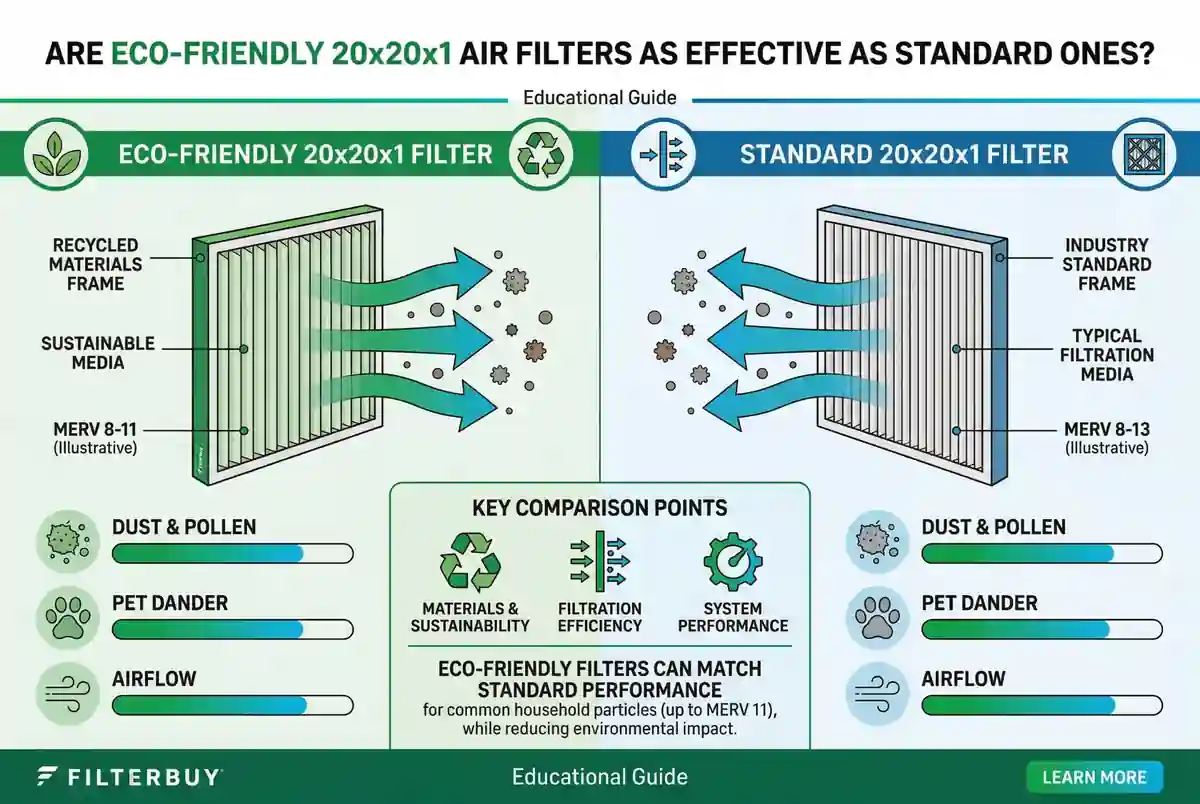
"Most homeowners assume eco-friendly filters are an either/or trade-off — you get sustainability or you get performance. After manufacturing filters for over a decade and testing hundreds of media and frame combinations, that's not what the data shows. What actually determines whether an eco-friendly filter protects your family is frame engineering, not filtration media. A recycled-content filter built with a rigid, moisture-resistant frame and a verified MERV rating will perform as reliably as any conventional filter on the market. The filters that fail don't fail because they're eco-friendly — they fail because they were built to a price point, not a performance standard."
Essential Resources
Don't take your indoor air for granted. The filter sitting in your HVAC system right now is either protecting your family from the dust, pollen, dander, and bacteria circulating through your home — or it isn't. After manufacturing filters for over a decade and serving more than two million households, we know that confident filter decisions start with the right knowledge. These seven resources give you exactly that.
1. Understand the Only Performance Standard That Actually Matters for Your Family's Air
Source: U.S. Environmental Protection Agency — What Is a MERV Rating? URL: https://www.epa.gov/indoor-air-quality-iaq/what-merv-rating
Most homeowners pick a filter by price or brand recognition. The Prudent Protector picks by MERV rating — the one number that tells you whether a filter will actually capture the particles threatening your family's health. The EPA's official MERV explainer is the place to start before any filter comparison.
2. See Exactly What's Floating Through Your Home — and How Filters Stop It
Source: U.S. Environmental Protection Agency — Guide to Air Cleaners in the Home URL: https://www.epa.gov/indoor-air-quality-iaq/guide-air-cleaners-home
Most pollutants in your home are completely invisible — which is exactly why they're so easy to ignore. This EPA consumer guide makes the invisible visible, explaining what your HVAC filter captures, what it can't, and how to match your filtration approach to your home's specific air quality challenges.
3. Find Out How Much a Filter Upgrade Actually Reduces Indoor Particles
Source: U.S. Environmental Protection Agency — Indoor Air Filtration Fact Sheet URL: https://www.epa.gov/sites/default/files/2018-11/documents/indoor_air_filtration_factsheet-508.pdf
Here's what the data actually shows: upgrading to a MERV 13 filter can reduce the concentration of indoor airborne particles by up to 95%. This EPA fact sheet puts real numbers behind filter performance — the kind of evidence that turns a purchasing decision into a confident one.
4. Know How Filter Changes Protect Both Your Air and Your HVAC Investment
Source: U.S. Department of Energy — Air Conditioner Maintenance URL: https://www.energy.gov/energysaver/air-conditioner-maintenance
A clogged 20x20x1 filter doesn't just degrade your air quality — it forces your HVAC system to work harder, drives up energy costs, and shortens the life of your equipment. The Department of Energy's maintenance guidance covers exactly how often to replace your filter and what's at stake when you don't.
5. Get Filter Performance Guidance from the Organization That Wrote the Standard
Source: ASHRAE — Filtration and Disinfection FAQ URL: https://www.ashrae.org/technical-resources/filtration-and-disinfection-faq
ASHRAE developed Standard 52.2 — the test method behind every MERV rating on every filter you'll ever buy. When you want to understand how filter ratings are determined, what change intervals are appropriate, and why MERV 13 is the residential benchmark for serious air quality protection, go straight to the source.
6. Shop 20x20x1 Filters Built to Perform — Made in the USA, Shipped in 24 Hours
Our 20x20x1 filters are manufactured in the USA with beverage board frames engineered to stay rigid through humidity and temperatures up to 200°F — because a filter that warps lets unfiltered air bypass the media entirely. Choose your MERV rating, understand your actual versus nominal sizing, and get the right filter delivered directly to your door.
7. Match Your MERV Rating to Your Household's Real Protection Needs
Source: Filterbuy Resource Center — Which MERV Rating Should I Use? URL: https://filterbuy.com/resources/air-filter-basics/which-merv-rating-should-I-use/
Pets, allergies, wildfire smoke, young children, respiratory sensitivities — every household has a different air quality profile. This guide draws on our experience manufacturing filters for millions of households to help you identify exactly which MERV rating protects your family without straining your HVAC system.
Supporting Statistics
After manufacturing filters for over a decade, we've seen these numbers play out in real homes. Here's what the research confirms — and what it means for the filter in your HVAC system right now.
According to the EPA, Americans spend approximately 90% of their time indoors — where concentrations of some pollutants are often 2 to 5 times higher than outdoor levels.
Most homeowners focus on outdoor pollution. The EPA's data tells a different story:
The greater exposure risk is already inside your home
Indoor pollutants cycle through your ductwork on every pass
Your air filter is the only active barrier between your HVAC system and that daily pollutant load
A filter isn't a passive component. It's a healthy decision.
Source: U.S. Environmental Protection Agency — Indoor Air Quality https://www.epa.gov/report-environment/indoor-air-quality
The EPA confirms that upgrading to a MERV 13 filter can reduce indoor airborne particle concentrations by up to 95%.
That 95% figure isn't automatic. At the manufacturing level, it requires:
Tighter media construction
Higher pleat counts
A frame engineered to hold its shape under sustained airflow pressure
Proper seating with no bypass gaps
A MERV 13 filter with a compromised frame delivering bypass air performs closer to zero than 95. The rating and the construction are inseparable.
Source: U.S. Environmental Protection Agency — Indoor Air Filtration Fact Sheet https://www.epa.gov/sites/default/files/2018-11/documents/indoor_air_filtration_factsheet-508.pdf
ASHRAE — the engineering body that created Standard 52.2 and governs every MERV rating in existence — recommends MERV 13 as the minimum filtration efficiency for residential and commercial settings.
Three things every filter buyer should understand about this recommendation:
ASHRAE's MERV designation is a floor, not a ceiling
When the organization that wrote the standard names a minimum, no marketing claim can override it
If a filter can't be validated against Standard 52.2, its MERV rating is unverifiable
We align our manufacturing specifications to ASHRAE's framework for exactly this reason.
Source: ASHRAE — Filtration and Disinfection FAQ https://www.ashrae.org/technical-resources/filtration-and-disinfection-faq
CDC data shows 8.6% of U.S. adults and 6.5% of U.S. children currently have asthma — tens of millions of Americans whose respiratory health is directly affected by indoor air quality.
Serving over two million households puts us close to this reality. For families managing asthma or respiratory sensitivities, filter performance isn't abstract. It shows up as:
Flare-up frequency
Sleep quality
How well a child breathes through the night
The difference between a filter that holds its MERV rating across its full service life and one that degrades at week six isn't a performance footnote. It's felt.
Source: CDC National Center for Health Statistics — FastStats: Asthma (2024) https://www.cdc.gov/nchs/fastats/asthma.htm
The U.S. Department of Energy identifies regular filter replacement as one of the most critical HVAC maintenance tasks a homeowner can perform — noting that clogged filters allow dirt to bypass the media and accumulate directly on the evaporator coil, reducing heat absorption capacity and accelerating system failure.
This is a failure sequence we recognize from the manufacturing side. It follows a predictable pattern:
Filter media reaches full load capacity
Airflow bypasses the media rather than passing through it
Particulate matter accumulates on the evaporator coil
Coil efficiency degrades — and system failure follows
At that point, the eco-friendly versus standard filter debate is irrelevant. A neglected filter of any construction actively damages the system it was meant to protect.
Source: U.S. Department of Energy — Air Conditioner Maintenance https://www.energy.gov/energysaver/air-conditioner-maintenance
Final Thoughts
The eco-friendly versus standard filter debate is the wrong question.
After manufacturing air filters for over a decade and serving more than two million households, the question we've learned to ask is simpler: is this filter built to perform, or built to sell?
We've tested hundreds of media and frame combinations. The difference between a filter that protects your family and one that doesn't has never been the eco-friendly label, even when compared to the best air purifiers. It's always been the engineering behind it.
Here's our honest assessment of where the industry stands:
The filtration media gap has largely closed. Recycled polyester and plant-fiber blends have matured into legitimate filtration materials. A well-engineered eco-friendly media can achieve MERV 8, MERV 11, and MERV 13 performance on par with conventional synthetic alternatives.
The frame engineering gap has not. Moisture-sensitive recycled cardboard frames remain the most consistent point of failure we observe in eco-friendly filter construction. Until the industry establishes a structural performance standard for frames — not just media — the bypass gap risk will persist.
Greenwashing is the real threat to the category. Sustainable filtration is a legitimate advancement. But eco-friendly branding without published ASHRAE 52.2 test data, pressure drop specifications, or frame material disclosures undermines the entire category — including the products that genuinely deliver on both.
Our bottom line:
The best eco-friendly 20x20x1 filter treats environmental responsibility and filtration performance as equal engineering requirements — not competing trade-offs. Those filters exist.
The verification checklist on this page gives you the framework to find them.
What the data, the standards, and our manufacturing experience all confirm comes down to this:
Clean air and environmental responsibility are not in conflict
They only appear that way when a filter is built to a price point instead of a performance standard
Your family deserves both — don't settle for a filter that only delivers one
FAQ on 20x20x1 Air Filter
Q: What is the actual size of a 20x20x1 air filter?
A: The 20x20x1 designation is a nominal size — not a physical measurement. The actual dimensions are approximately 19.5" x 19.5" x 0.75".
Sizing errors are one of the most common and most avoidable causes of filtration failure we see. Two rules from our manufacturing experience:
Measure the slot opening directly
Never rely solely on the size printed on your existing filter
A filter with visible gaps around the frame isn't protecting your air. It's decorating your filter slot.
Q: What MERV rating should I choose for my 20x20x1 air filter?
A: Most buying mistakes happen at the extremes — under-buying on MERV to save money, or over-buying beyond what the HVAC system can handle. Here is the framework we apply from serving over two million households:
MERV 8 — Dust, pollen, lint, mold spores. The performance floor for meaningful residential filtration.
MERV 11 — Pet dander, fine dust, smaller allergens. The practical choice for pets or mild sensitivities.
MERV 13 — Smoke, bacteria, particles down to 0.3 microns. The right choice for asthma, respiratory conditions, or wildfire smoke exposure.
One critical caveat: always verify your system's rated operating static pressure before selecting MERV 13. A high-performing filter in an underpowered system creates airflow restriction that causes more harm than the filtration benefit it delivers.
Q: How often should I replace my 20x20x1 air filter?
A: Every 90 days is the baseline. Household conditions compress that window faster than most homeowners expect:
Pets: Every 60 days
Allergies or asthma: Every 45 to 60 days
Young children: Every 60 to 90 days
Wildfire smoke or high outdoor pollution: Every 30 days or sooner
The detail most homeowners miss: a filter doesn't gradually underperform as it ages. It reaches a saturation point where:
Airflow bypasses the media entirely
The filter stops capturing particles
Particulate matter deposits directly onto the evaporator coil
Change on schedule. Not when you remember.
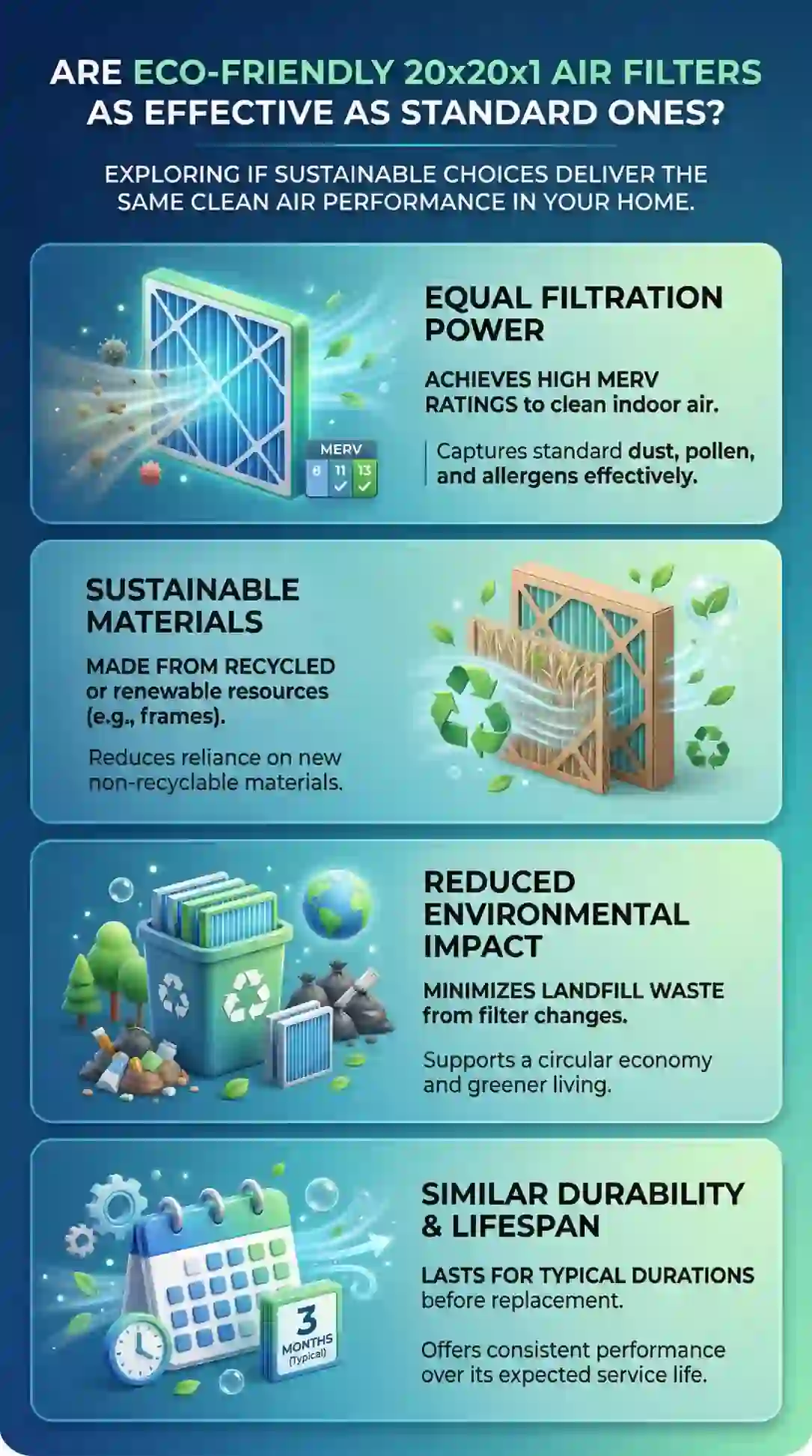
Q: Are eco-friendly 20x20x1 air filters as effective as standard ones?
A: Yes — with one condition our manufacturing experience makes it impossible to overlook. Well-built eco-friendly media can match MERV 8, MERV 11, or MERV 13 performance. The consistent failure point is the frame, not the media.
Moisture-sensitive recycled cardboard frames soften under airflow pressure. They create bypass gaps that make the MERV rating meaningless. Before purchasing any eco-friendly filter, confirm all three of the following:
MERV rating verified against ASHRAE Standard 52.2 — not self-reported
Rigid, moisture-resistant frame construction
Published pressure drop specification from the manufacturer
A filter that meets all three is a sound investment. A filter that can't document all three is a liability dressed in green packaging.
Q: What happens if I use the wrong size air filter in my HVAC system?
A: A filter that is too small creates gaps. Air takes the path of least resistance. The system runs, the filter sits in place, and your family assumes the air is being filtered. It isn't.
The consequences follow a predictable sequence:
Unfiltered air circulates freely through your living spaces
Particulate matter accumulates on the blower motor, evaporator coil, and ductwork
Coil efficiency degrades, energy costs rise, and system lifespan shortens
A filter that is too large creates the opposite problem — compressed frames that distort the media and reduce filtration efficiency across the entire surface area.
The 20x20x1 nominal filter fits systems designed for that slot at an actual size of approximately 19.5" x 19.5" x 0.75". When in doubt, measure the slot opening directly.
Shop Eco-Friendly 20x20x1 Air Filters Built to Perform
You now know what separates an eco-friendly 20x20x1 filter that genuinely protects your family's air from one that only looks the part — so don't settle for green packaging without the engineering to back it up. Shop Filterbuy's American-made 20x20x1 air filters, choose your MERV rating with confidence, and get clean air delivered directly to your door.