Smoke is a two-part threat. Fine particulate matter — the invisible PM2.5 particles that penetrate deep into the lungs — requires a high-efficiency particulate filter to capture. Activated carbon targets gases, odors, and volatile organic compounds. Neither does the other's job. Run carbon filtration alone during a smoke event, and those particles move through your system unblocked.
That distinction matters most when air quality is at its worst. This page breaks down exactly what a carbon filter can do, where it performs best, and which filter combination gives your home stronger wildfire protection — so you can make a confident, informed choice before smoke ever becomes a problem.
TL;DR Quick Answers
carbon filter
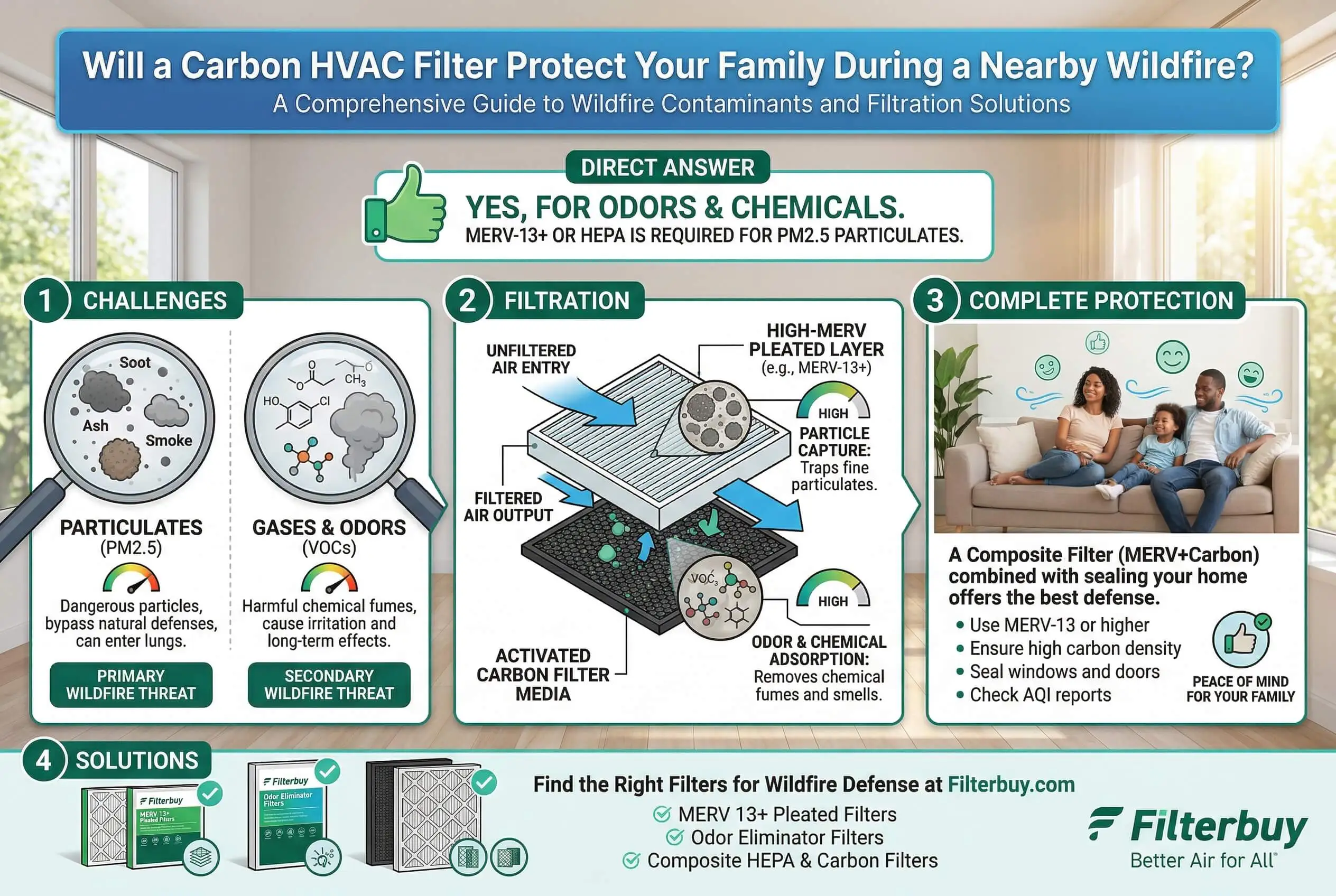
A carbon HVAC filter uses activated carbon media to capture gases, VOCs, and odors — but it does not capture fine particulate matter (PM2.5). During a wildfire, smoke is a two-part threat: harmful gases and fine particles. A carbon filter addresses only the gases. For complete wildfire protection, you need a MERV 13 filter with an integrated carbon layer — one filter that intercepts both PM2.5 particles and harmful gases simultaneously. After manufacturing filters for over a decade and serving more than two million households, this is the combination we recommend when air quality is at its worst.
Carbon filter: Captures gases, VOCs, and odors
MERV 13 filter: Captures fine particles including PM2.5
MERV 13 with carbon layer: Captures both — the only complete wildfire smoke solution
Change frequency during wildfire season: Every two to three weeks when AQI exceeds 150
Top Takeaways
A carbon HVAC filter addresses gases and odors — not particles.
Wildfire smoke is a two-part threat: VOCs and PM2.5 fine particles
Carbon filtration intercepts gases. It cannot capture particles
A carbon-only filter leaves half the threat unaddressed
MERV 13 is the minimum rating that meaningfully protects against wildfire smoke particles.
MERV 11 removes roughly 20% of particles in the PM2.5 size range
MERV 13 removes at least 50% of those same particles
That is more than double the protection where it matters most
The right wildfire filter is a MERV 13 with an activated carbon layer.
Intercepts both fine particles and harmful gases in a single filter
No separate products or HVAC modifications required
Confirm system compatibility, verify proper fit, and increase change frequency during active smoke events
Closing your windows is not the same as being protected.
Indoor PM2.5 still reaches 33% to 44% of outdoor smoke concentrations in homes with central HVAC and closed windows
Staying indoors is essential — but without active MERV 13 filtration, you are recirculating smoke, not filtering it
Filter thickness and fan mode compound your protection in ways most homeowners overlook.
A 4-inch MERV 13 filter delivers more than double the air cleaning performance of a standard configuration
Running your system fan continuously — not just during heating or cooling cycles — turns your HVAC into a round-the-clock air cleaner
Both details matter most when outdoor AQI stays above 150 for days at a time
What Carbon Filters Are Actually Designed to Do
Activated carbon is one of the most effective materials ever developed for neutralizing airborne gases. Inside a carbon HVAC filter, a highly porous carbon media — typically derived from coconut shell or coal — traps gas molecules through a process called adsorption. The gas binds to the carbon's surface rather than passing through.
During a wildfire, that capability matters. Smoke carries acrolein, formaldehyde, benzene, and a range of other volatile organic compounds (VOCs) that standard filters cannot touch. These are the gases responsible for the sharp, acrid smell that seeps into your home even with windows closed. A carbon filter intercepts them.
What it cannot do is stop particles. Activated carbon media has no meaningful mechanical filtration capability against PM2.5 — the fine particulate matter that makes wildfire smoke genuinely dangerous to respiratory health. For particles, you need a different filtration mechanism entirely.
Why Particles Are the Greater Health Threat
PM2.5 refers to airborne particles smaller than 2.5 microns in diameter. To put that in perspective, a human hair is roughly 70 microns wide. These particles are small enough to bypass the body's natural defenses and penetrate deep into the lungs — and in heavy smoke events, they accumulate in indoor air faster than most homeowners expect.
During a wildfire, indoor PM2.5 levels can climb significantly even in a home with all windows and doors sealed. The particles infiltrate through every gap in a building's envelope: door frames, electrical outlets, HVAC duct joints. Once inside, they circulate continuously through your system. Without a high-efficiency particulate filter intercepting them on every air cycle, concentration levels build.
The health consequences are not mild. Short-term exposure to elevated PM2.5 triggers respiratory irritation, aggravates asthma and chronic lung conditions, and increases cardiovascular stress. Children, elderly family members, and anyone with a pre-existing respiratory condition face the highest risk.
The MERV Rating That Actually Addresses Wildfire Smoke
MERV — Minimum Efficiency Reporting Value — measures a filter's ability to capture particles across a range of sizes. The higher the MERV rating, the smaller the particles the filter can intercept.
For wildfire smoke protection, MERV 13 is the minimum rating that meaningfully captures PM2.5. A MERV 13 filter can intercept particles as small as 0.3 to 1.0 microns, which covers the PM2.5 size range that poses the greatest respiratory risk. MERV 8 and MERV 11 filters, while effective for everyday dust and allergens, are not engineered to address fine wildfire smoke particles at meaningful efficiency levels.
In our experience manufacturing filters and working with households across wildfire-prone regions, the customers who call us during smoke events almost always have a MERV 8 or MERV 11 filter installed — and no carbon layer. Both gaps matter, but the particle gap is the one most likely to affect your family's health.
The Right Filter Combination for Wildfire Season
The most effective single-filter solution for wildfire events is a MERV 13 filter with an activated carbon layer. This combination addresses both threats simultaneously: the carbon layer captures gases and VOCs, while the MERV 13 media intercepts fine particles. You get complete coverage without requiring separate filtration products or HVAC modifications.
A few important considerations when selecting this combination:
Confirm your HVAC system can handle a MERV 13 filter. Most modern systems can, but older or lower-capacity units may experience airflow restriction at higher MERV ratings. If airflow is a concern, MERV 11 with a carbon layer is a better choice than forcing an incompatible filter.
Check your filter size carefully. A filter that doesn't seat properly creates gaps at the frame — and unfiltered air bypasses everything, including the carbon layer.
Increase your change frequency during smoke events. A filter working hard against heavy smoke loads will clog faster than under normal conditions. In severe events, check your filter every two to three weeks rather than monthly.
How Often to Change Your Filter During a Wildfire Event
Under typical household conditions, a MERV 13 filter with carbon lasts 60 to 90 days. During an active wildfire event with sustained poor air quality, that timeline compresses considerably. Heavy smoke loads saturate both the carbon layer and the particulate media faster than everyday pollutants do.
A practical rule: if the AQI in your area has been above 150 — the Unhealthy threshold — for more than a week, inspect your filter. A filter that looks uniformly gray or dark across the entire surface is approaching the end of its effective life. Replace it before it becomes so loaded that air begins bypassing the media rather than passing through it. A clogged filter doesn't just stop protecting — it can restrict airflow enough to strain your HVAC system.
What Your HVAC System Alone Cannot Do
Even the right filter combination has limits that are worth understanding. Your HVAC system only filters air when it is actively running. If your system cycles off, particulates suspended in your indoor air are not being captured. During a serious smoke event, running your system in fan-only mode — if your thermostat supports it — keeps air circulating through the filter continuously, even when heating or cooling isn't needed.
Your HVAC system also cannot address the air that infiltrates directly into living spaces through gaps in your building envelope. A portable air purifier with a true HEPA filter adds a meaningful second layer of protection in bedrooms and common areas where your family spends the most time. It is not a replacement for proper HVAC filtration — it is a complement to it.
"Most homeowners assume that any filter labeled 'carbon' is giving their family complete wildfire protection — and that assumption is exactly what we work to correct. After manufacturing filters for over a decade and serving more than two million households, we know that carbon filtration and particulate filtration are two separate jobs. Wildfire smoke demands both. A carbon-only filter will neutralize the odor and gases, but the PM2.5 particles that cause the most serious respiratory damage will pass right through it. The filter combination that actually protects your family during a smoke event is a MERV 13 with an activated carbon layer — and it needs to be the right size, properly seated, and changed more frequently than your normal schedule. Getting one of those details wrong during an active wildfire is the difference between a home that's genuinely protected and one that only feels like it is."
Essential Resources
Don't take your indoor air for granted during a wildfire — especially when the filter in your system may only be solving half the problem. After manufacturing filters for over a decade and helping more than two million households breathe cleaner air, we know that the homeowners who protect their families best are the ones who do their research before smoke arrives. These seven authoritative resources from government agencies and industry standards bodies give you the science, the guidance, and the real-time tools to make confident filtration decisions when it matters most.
EPA Wildfires and Indoor Air Quality — The HVAC Guidance Every Homeowner Needs Before Wildfire Season
This is the EPA's go-to resource for protecting indoor air during wildfire events, covering HVAC filter selection, recirculation settings, and specific steps for reducing smoke infiltration in your home. If you only read one resource before fire season, make it this one. https://www.epa.gov/emergencies-iaq/wildfires-and-indoor-air-quality-iaq
EPA Indoor Air Filtration Fact Sheet — See Exactly What Each MERV Rating Does and Doesn't Capture
This downloadable EPA fact sheet breaks down filter efficiency by MERV rating and makes the particle-versus-gas gap impossible to ignore. Keep it handy when comparing your current filter against what wildfire smoke actually demands from your system. https://www.epa.gov/sites/default/files/2018-11/documents/indoor_air_filtration_factsheet-508.pdf
EPA Air Cleaner Research — The Proof Behind Why MERV 13 Is the Standard for Wildfire Smoke Protection
EPA-conducted research confirming MERV 13 as the filter rating that meaningfully captures PM2.5 wildfire smoke particles, with findings that show how filter thickness and design directly impact real-world performance. This is the science behind the recommendation — not just the recommendation itself. https://www.epa.gov/air-research/research-diy-air-cleaners-reduce-wildfire-smoke-indoors
AirNow Fire and Smoke Map — Know When Outdoor Air Quality Is Bad Enough to Demand Action Indoors
A real-time interactive map tracking wildfire locations, smoke plumes, and AQI readings across the United States. This is the tool that tells you when it's time to check your filter, close the fresh air intake, and run your system on recirculate — before indoor air quality has already declined. https://fire.airnow.gov/
AirNow Fires and Your Health — Understand the AQI Thresholds That Put Your Family at Real Risk
Health guidance from the EPA and NOAA explaining how wildfire smoke affects respiratory health at each AQI level — and the specific indoor steps recommended as conditions worsen. Directly relevant to knowing when to change your filter ahead of schedule and when to run your system continuously. https://www.airnow.gov/air-quality-and-health/fires-and-your-health/
CDC Wildfire Safety Guidelines — Protect Every Member of Your Household, Including the Most Vulnerable
The CDC's household-level wildfire smoke guidance covers HVAC filter recommendations, how to set up a cleaner air room, and specific precautions for children, older adults, and anyone with asthma or a chronic respiratory condition. If someone in your home is in a high-risk group, this resource belongs in your wildfire preparedness plan. https://www.cdc.gov/wildfires/safety/how-to-safely-stay-safe-during-a-wildfire.html
ASHRAE Filtration and Disinfection FAQ — Understand the Standard That Defines Every MERV Rating on the Market
ASHRAE Standard 52.2 is the technical foundation behind every MERV rating claim you'll encounter — defining how filters are tested, what each rating guarantees, and why the testing methodology matters when evaluating real-world smoke protection. In our experience, this is the resource that separates informed filter buyers from homeowners who rely on packaging alone. https://www.ashrae.org/technical-resources/filtration-and-disinfection-faq
Supporting Statistics
Most homeowners assume that closing the windows and running the HVAC is enough during a wildfire. The numbers tell a more sobering story. After manufacturing filters for over a decade and serving more than two million households, we've seen firsthand what happens when families rely on the wrong filter combination during a smoke event. These four statistics from U.S. government agencies explain why the filter in your system right now may not be doing what you think it is.
Wildfire Smoke Is Now the Leading Source of PM2.5 Pollution in the United States — Not Traffic, Not Industry
This single statistic reframes the entire conversation about indoor air quality:
The EPA's 2020 National Emissions Inventory found wildland fires account for 52% of all PM2.5 emitted across the U.S.
Fine particulate matter most dangerous to your lungs now comes primarily from fire smoke — not exhaust, not factories
Wildfire smoke is not a regional problem for people near fire zones. It is a national air quality threat
A carbon-only filter captures none of these particles
This is usually the statistic that changes the conversation for the homeowners we work with.
U.S. Environmental Protection Agency — Wildland Fire Research: Reducing Exposures https://www.epa.gov/air-research/wildland-fire-research-reducing-exposures
Staying Inside During a Wildfire Is Necessary — But It Is Not the Same as Being Protected
One of the most common misconceptions we encounter: a sealed home keeps wildfire smoke out. EPA-referenced modeling data shows exactly how far from the truth that is:
Homes with central HVAC and closed windows: indoor PM2.5 still reached 33% to 44% of outdoor smoke concentrations
Homes with typical air infiltration and no central air: that figure climbed to 64% to 80%
Homes with open windows: indoor PM2.5 reached 83% to 95% of outdoor levels
Smoke infiltrates through door frames, electrical outlets, and duct joints on every air cycle. Staying indoors is the right call. Without an active MERV 13 filter running continuously, you are not filtering that air — you are recirculating it.
Lawrence Berkeley National Laboratory — IAQ Scientific Findings Resource Bank: Wildfires https://iaqscience.lbl.gov/wildfires
The Gap Between MERV 11 and MERV 13 Is Not a Minor Upgrade — It Is More Than Double the Protection Where It Matters Most
This is the insight that surprises homeowners more than any other. EPA filtration data on particles in the 0.3 to 1 micron range — the PM2.5 size category most responsible for respiratory damage from wildfire smoke:
MERV 11 removes roughly 20% of particles in this range
MERV 13 demonstrates at least 50% removal efficiency for the same particles
That is more than double the protection in the exact size range wildfire smoke targets
In our experience, this is where the real protection gap lives — not between having a filter and not having one, but between assuming MERV 11 is close enough and understanding it is not designed for what wildfire smoke actually is. If your system can accommodate MERV 13, there is no reason to settle for less during fire season.
U.S. Environmental Protection Agency — Air Filtration Technical Bulletin https://www.epa.gov/sites/default/files/2020-06/documents/2019.11_tech_bulletin_filtration.pdf
Filter Thickness Is Not a Detail — It Compounds Your Protection by More Than You Would Expect
Most wildfire filtration conversations focus on MERV rating. Fewer address filter thickness. In our experience manufacturing filters across hundreds of sizes, that second variable carries more weight than most homeowners realize:
A single 4-inch MERV 13 filter increased measurable air cleaning performance by 123% in EPA research — more than doubling the Clean Air Delivery Rate
A 1-inch MERV 13 filter still provides meaningful protection for systems that cannot accommodate a deeper filter
When your system can run a 4-inch filter, the performance difference during a sustained smoke event shows up in three ways:
How quickly your filter loads under heavy smoke
How consistently your indoor air stays clean between changes
How much protection your family actually receives when outdoor AQI stays above 150 for days at a time
U.S. Environmental Protection Agency — Research on DIY Air Cleaners to Reduce Wildfire Smoke Indoors https://www.epa.gov/air-research/research-diy-air-cleaners-reduce-wildfire-smoke-indoors
Final Thoughts
Here is the honest summary: a carbon HVAC filter does its job exceptionally well. It neutralizes gases, VOCs, and the acrid odors that make wildfire smoke immediately unpleasant indoors. The problem is not that carbon filtration doesn't work. The problem is that wildfire smoke is a two-part threat — and a carbon-only filter is a one-part answer.
After manufacturing filters for over a decade and serving more than two million households, our opinion is consistent: homeowners who protect their families best during wildfire events are the ones who understand how each layer of filtration works, and a MERV 8 filter can play a positive, practical role as part of that strategy by helping capture larger airborne particles while supporting steady airflow throughout the home.
What that understanding looks like in practice:
A MERV 13 filter with an activated carbon layer handles both threats — particles and gases — without requiring separate products or HVAC modifications
Filter fit matters as much as filter rating. A poorly seated filter creates bypass gaps that render both the particulate media and the carbon layer ineffective
Changing your filter more frequently during wildfire season is not optional maintenance — it is active protection. A saturated filter restricts airflow and reduces whole-home air circulation
Running your system's fan continuously during a smoke event turns your HVAC into a round-the-clock air cleaning system — not just an intermittent one
Our broader opinion — and one we hold with conviction:
The air filtration industry has a responsibility to be clearer about what carbon filtration is and is not designed to do. Carbon filters are frequently marketed around wildfire season in ways that imply complete smoke protection. They do not provide it alone. A homeowner who buys a carbon filter believing their family is fully protected is a homeowner who has been underserved by the information available to them. That is precisely the gap this page exists to close.
Wildfire smoke now accounts for more than half of all PM2.5 emitted in the United States. That is not a niche air quality problem. It deserves a filtration response that matches the actual scale and composition of the threat — not a single-layer solution that addresses only half of what smoke actually is.
You are the hero of your household when it comes to protecting your family's air. The right filter combination — properly fitted, changed on schedule, and running continuously during a smoke event — is one of the most effective steps you can take. We have spent over a decade manufacturing the filters that make that protection possible, and we will keep obsessing over every detail so you can breathe easier knowing your home is genuinely covered.
FAQ: Carbon Filter
Q: Will a carbon HVAC filter protect my family from wildfire smoke?
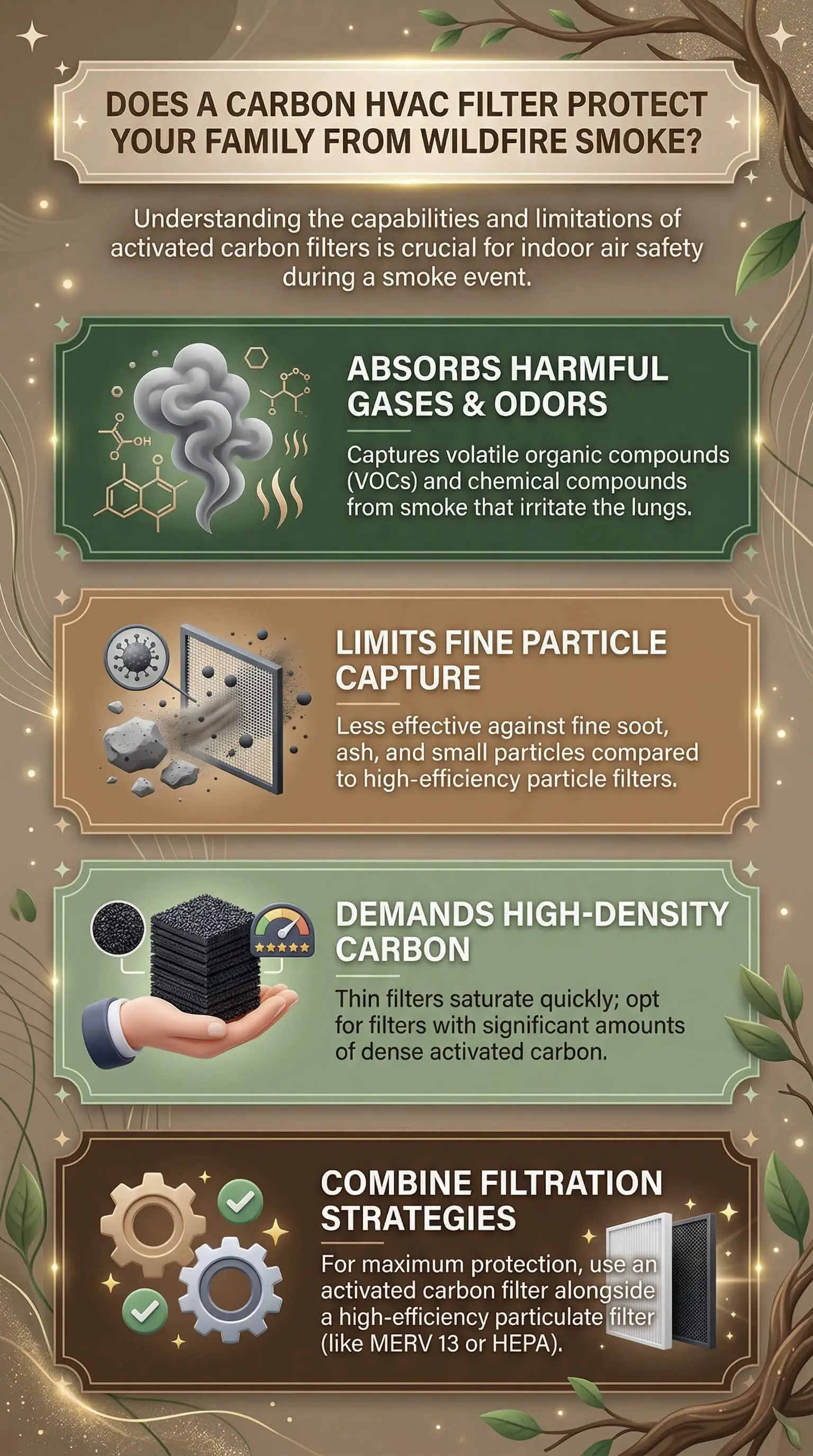
A: Partially — but not completely, and that distinction matters more than most homeowners realize. Carbon filtration does one job exceptionally well:
Neutralizes gases, VOCs, and odors wildfire smoke carries indoors
Cannot capture PM2.5 — the fine particles that cause the most serious respiratory damage
Leaves the particle threat completely unaddressed
After manufacturing filters for over a decade, our recommendation is consistent: the filter that delivers real wildfire protection is a MERV 13 with an integrated carbon layer. One product. Both threats were handled. No HVAC modifications required.
Q: What is the difference between a carbon filter and a MERV 13 filter?
A: They solve different problems — and confusing the two is the most common filtration mistake we see during wildfire season.
Carbon filter: Uses activated carbon media to adsorb gases, VOCs, and chemical compounds responsible for smoke odor and irritation
MERV 13 filter: Uses dense mechanical media to physically intercept fine particles in the PM2.5 size range
Neither does the other's job
In our experience serving households across wildfire-prone regions, families who assume a carbon filter is a complete smoke solution are the ones most likely to call us mid-event — wondering why their home still smells like smoke and why family members are still experiencing symptoms.
Q: How often should I change my carbon HVAC filter during a wildfire?
A: More often than the label says. Under normal conditions, a MERV 13 carbon filter lasts 60 to 90 days. During an active wildfire event, heavy smoke loads collapse that timeline significantly. Here is the practical schedule we recommend:
Check your filter every two to three weeks when outdoor AQI exceeds 150
Replace immediately if the media looks uniformly dark or gray across the entire surface
Do not wait for reduced airflow to signal a change — at that point the filter is overloaded and your system is already under strain
Stock a spare filter before fire season starts. When air quality deteriorates quickly, shipping timelines work against you.
Q: Can I use a carbon filter and a MERV 13 filter together in my HVAC system?
A: We strongly advise against it. Stacking two filters in a standard residential system creates three compounding problems:
Dramatically increases airflow resistance
Strains the blower motor and reduces whole-home air circulation
Risks long-term equipment damage
The cleaner solution is a single MERV 13 filter with an integrated carbon layer:
One product. One installation. No airflow penalty beyond a standard MERV 13
Always confirm MERV 13 compatibility with your system before upgrading
Older or lower-capacity units may require professional guidance
Q: Does a carbon filter help with wildfire smoke smell inside the house?
A: Yes — and this is the one area where carbon filtration has no equal. The sharp, acrid smell of wildfire smoke comes from:
VOCs, benzene, acrolein, and formaldehyde released during combustion
Gases that activated carbon is specifically engineered to capture
Here is what surprises most homeowners: even after the odor clears, PM2.5 particles are still circulating. They are:
Odorless
Invisible
Not captured by a carbon-only filter
Odor relief and respiratory protection are not the same thing. Treating them as equivalent is the gap that puts families at risk during smoke events. For both, the answer is a MERV 13 with an integrated carbon layer — changed on an accelerated schedule while outdoor AQI remains elevated.
Is Your Home's HVAC Filter Ready for Wildfire Season? Shop Filterbuy's MERV 13 Carbon Filters and Get the Complete Wildfire Protection Your Family Deserves.
When wildfire smoke is moving toward your neighborhood, the wrong filter is not a minor inconvenience — it is a gap in your family's protection that shows up in the air they breathe every hour your system runs. Find your filter size, upgrade to a MERV 13 with an integrated carbon layer, and take the one step that addresses both threats wildfire smoke actually presents.