TL;DR Quick Answers
Chicago Air Quality
Chicago's air quality changes hour by hour, driven mostly by ground-level ozone in summer and fine particulate matter (PM2.5) from traffic and wildfire smoke. Check a live reading before heading outside, since one citywide number can hide neighborhood-level spikes near expressways or the lakefront.
Current conditions: Track a live, hour-by-hour reading rather than a single daily average.
Main pollutants: Ground-level ozone (summer afternoons) and PM2.5 (traffic, industry, wildfire smoke).
Cleanest hours: Early morning, before traffic builds and ozone forms.
Indoor protection: A high-MERV air filter catches what still gets past your windows and doors once outdoor air quality drops.
Top Takeaways
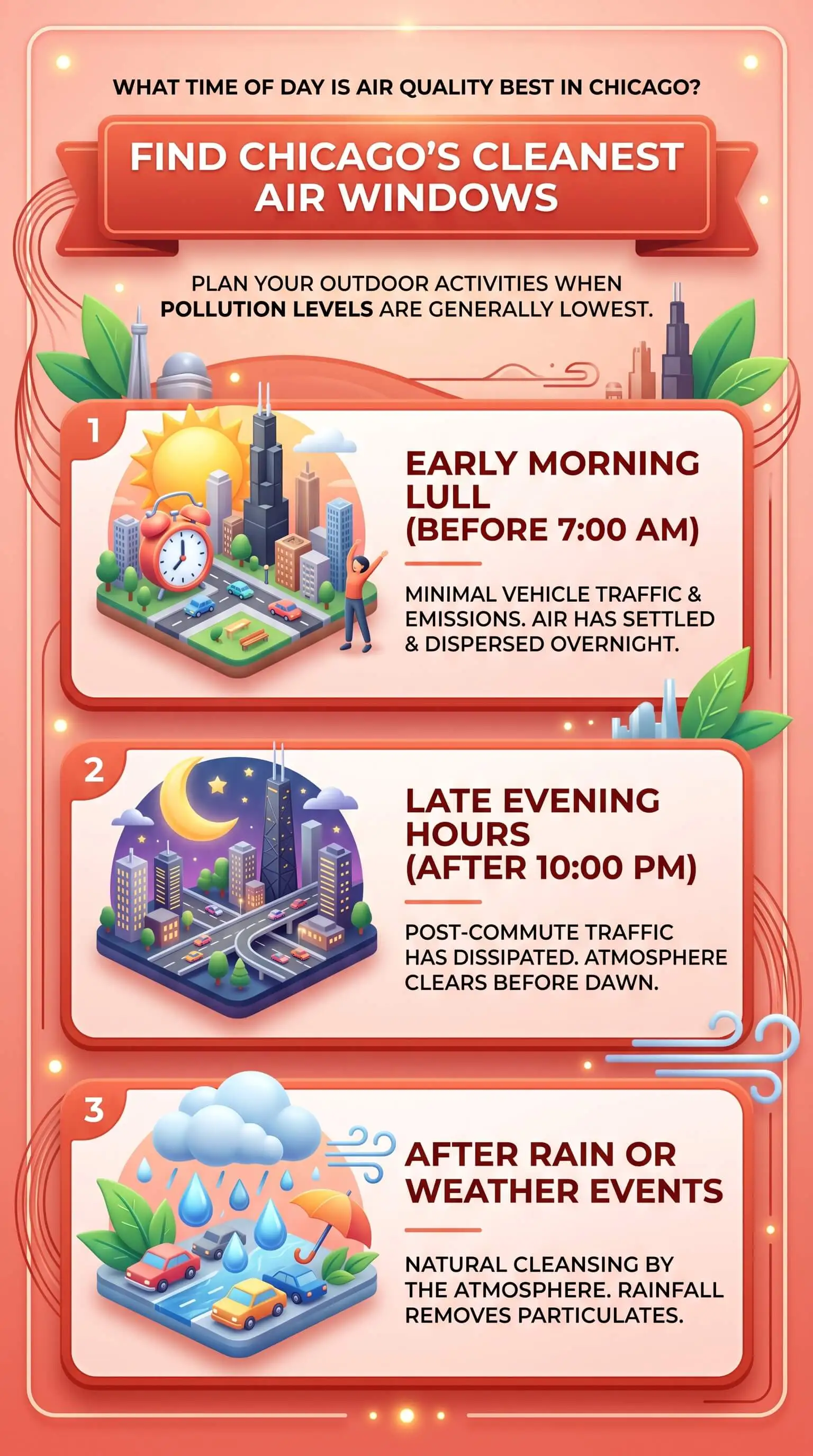
Early morning, before traffic builds, is usually the cleanest window in Chicago on most days of the year.
Summer afternoons carry the highest ozone risk, especially on hot, sunny, low-wind days.
Winter mornings can trap particulate matter longer thanks to slower-clearing temperature inversions.
Lake Michigan's lake breeze can push ozone back onto the shoreline well into the evening.
A live AQI reading beats a general rule of thumb for today's specific plans, every time.
Chicago's air moves through a pattern I've come to know well.
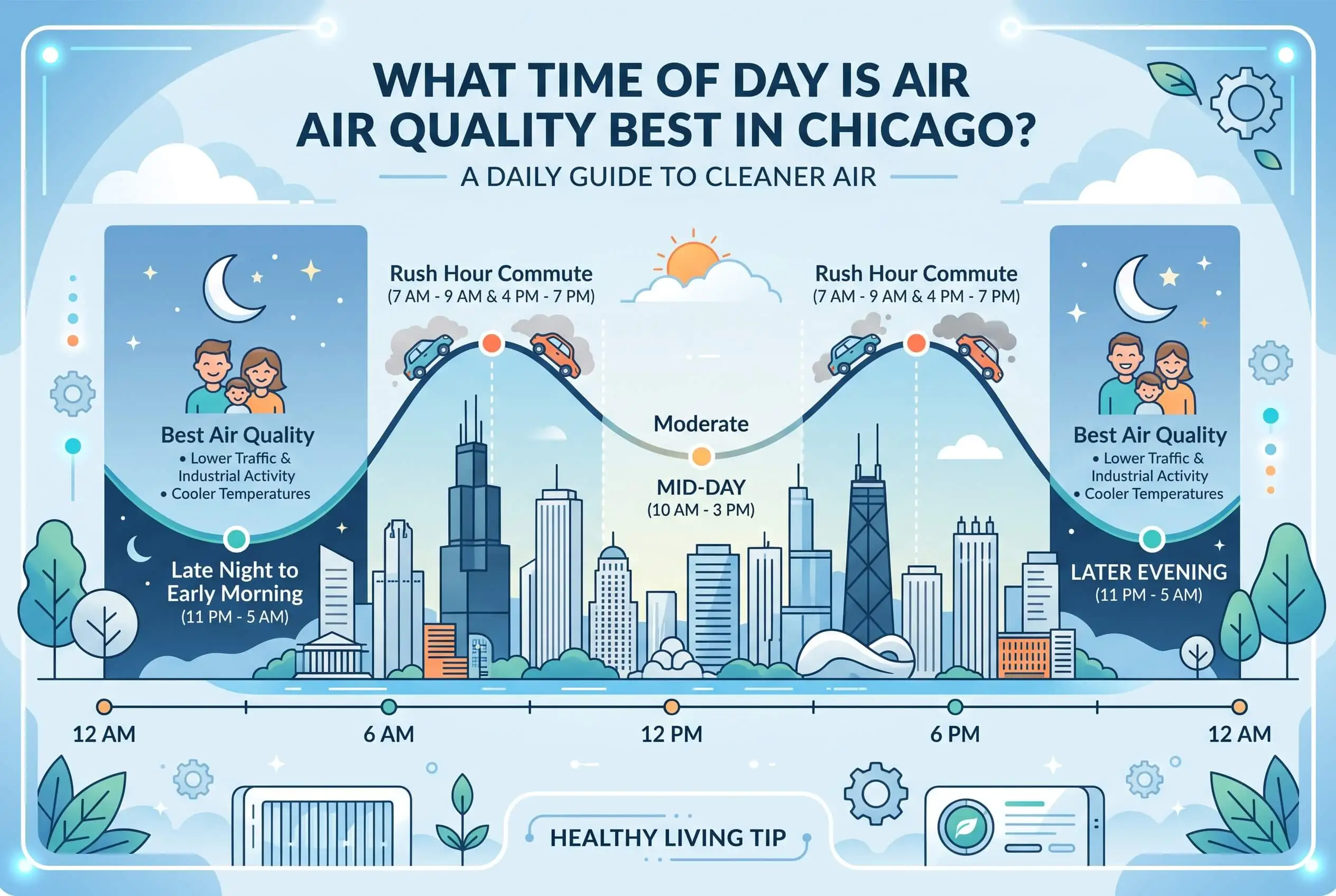
Overnight, the air near the ground often settles into a temperature inversion. Cooler air sits close to the surface while a warmer layer traps it in place. That layer holds the previous day's particulates near street level until the sun breaks it apart. This is one reason the first hours of the morning, before traffic builds, tend to offer the cleanest air of the day, making it an ideal time to rely on a quality air filter to help maintain cleaner indoor air.
Then the commute starts. Vehicle emissions add nitrogen oxides and fine particulate matter to the mix. Traffic-heavy corridors along the expressways and near O'Hare see the sharpest short-term spikes, even on days that read as moderate citywide.
Ozone takes over from there. From late morning through the afternoon, especially between May and September, sunlight and heat drive ground-level ozone formation. Ozone isn't emitted directly. It forms when vehicle and industrial emissions react with sunlight, and that reaction peaks in the hottest, brightest hours of the day. I treat this window with the most caution every summer.
Lake Michigan adds its own twist. On many summer afternoons, a lake breeze develops as cooler air over the water pushes inland, and that breeze can carry ozone and its precursor pollutants back onto the shoreline in the afternoon and early evening, well after the morning commute has cleared. Neighborhoods closer to the lakefront feel this more directly than inland areas do.
Evening brings a second, smaller bump from the commute. It's usually milder than the summer ozone peak or the winter morning inversion.
Winter flips the pattern. Ozone formation drops off with the shorter, cooler days. But the same kind of temperature inversion that clears out by mid-morning in summer can linger longer on a still, cold winter day, holding particulate matter closer to the ground for more of the daylight hours.
None of this replaces checking a live reading before you head out. It tells you which hours are worth checking first.
"Once afternoon temperatures climb past 85 degrees on a still day, I already know ground-level ozone is going to be the bigger problem for Chicago, not the morning traffic pollution most people worry about first."
7 Essential Resources
See Chicago's Real-Time AQI Before You Head Out
AirNow's official AQI guide breaks down what the color-coded categories mean and how to read a live reading for your neighborhood. Read the AQI basics at AirNow.gov
Track Illinois' Daily Ozone Forecasts and Action Days
The Illinois EPA issues Chicago-area air pollution forecasts and calls Air Pollution Action Days when conditions are expected to turn unhealthy. View Illinois EPA's outdoor air page
Check Hyperlocal Readings From Chicago's Own Sensor Network
Open Air Chicago runs nearly 280 community sensors across the city. It fills in the gaps between federal monitoring stations with neighborhood-level detail. Explore Open Air Chicago
Get Chicago's Official Weather and Air Quality Alerts
The National Weather Service's Chicago forecast office issues the air quality alerts and hazardous weather outlooks that often line up with the timing patterns above. Visit NWS Chicago
Understand How Air Quality Data Gets Tracked Nationwide
The CDC's Environmental Public Health Tracking Network explains how monitored and modeled air data come together, and why that matters for public health decisions. See the CDC's tracking program
Learn When It's Safest to Exercise Outdoors
The American Lung Association lays out how ozone timing should shape when you schedule a run, ride, or outdoor workout. Read the Lung Association's exercise guidance
Reach Local Health Guidance for the Chicago Suburbs
The Cook County Department of Public Health's Environmental Health division fields air quality and environmental health concerns across suburban Cook County. Visit Cook County Public Health
Use these trusted air quality testing resources to check real-time AQI, forecasts, local sensor data, health alerts, and outdoor conditions before spending time outside in Chicago.
3 Statistics
Ground-level ozone concentrations usually peak during afternoon hours, when sunlight is most intense, according to the EPA.
NASA-funded modeling of ozone circulation around Lake Michigan improved forecast resolution from 12 kilometers down to 1.3 kilometers. That's an accuracy gain of more than 30 percent, according to NASA.
The cool air carried inland by a Lake Michigan lake breeze stays confined to roughly the lowest 200 meters of the atmosphere, according to NOAA-funded research from the 2017 Lake Michigan Ozone Study.
These outdoor air quality statistics also highlight why maintaining an air conditioning filter is important, as cleaner indoor airflow can help reduce exposure when ozone and pollution levels rise outside.
Final Thoughts and Opinion
There's no single best hour for Chicago air that holds up 365 days a year, and I stopped looking for one. What actually works is treating the pattern as a starting point, not a rulebook. Check the live number, then decide. Mornings win most of the time. Summer afternoons earn extra caution. Lake Michigan is the wildcard inland cities don't have to think about. I'd rather trust today's reading over yesterday's habit, and the same principle applies to indoor air quality testing, where checking current indoor conditions gives you a clearer picture than relying on assumptions. That's the one opinion on this topic I'll stand behind.
Frequently Asked Questions
Is Chicago's air quality better in the morning or evening?
Morning usually wins, especially before ozone season runs from roughly May through September. Evenings can carry a secondary rush-hour bump and, in summer, the tail end of the afternoon's ozone buildup, making air quality testing a smart way to confirm conditions before spending time outdoors.
Does Chicago's air quality change with the seasons?
Yes. Ozone drives most of the summer risk. Particulate matter trapped by temperature inversions is more often the winter concern, making a high-quality air purifier especially helpful for improving indoor air when outdoor pollution levels rise.
What AQI number is safe for outdoor exercise in Chicago?
An AQI under 100 is generally fine for most people. Above 100, sensitive groups should consider a lighter activity or an earlier time slot. Above 150, that caution extends to nearly everyone.
Does the wind off Lake Michigan affect Chicago's air quality?
It can. A lake breeze on a hot, sunny afternoon can carry ozone and its precursor pollutants back toward the shoreline, sometimes keeping levels elevated later into the evening than inland neighborhoods experience.
Ready to Plan Around Today's Air
A general pattern is a useful starting point. It can't tell you what's happening in your neighborhood at this exact hour. Check today's live Chicago AQI reading before you head out, and let the number, not the clock, make the final call—even if you use a top air filter at home to help maintain cleaner indoor air.