You're far from alone. When Swedish researchers surveyed 9,051 healthcare workers, 31% reported hand eczema within a single year.
Hand dermatitis turns up so often in healthcare that dermatologists treat it as an occupational condition, and soap-and-water washing is one of its biggest drivers. The right hand soap for eczema helps. Getting your hands wet less often helps even more.
We built this guide from CDC guidance, the American Contact Dermatitis Society and the National Eczema Association. None of it replaces your facility's hand hygiene policy. It's here to make that policy easier on your skin.
TL;DR Quick Answers
Hand soap for eczema
The short answer: the best hand soap for eczema is truly fragrance-free, sulfate-free and dye-free, and gentle enough to use many times a day. If you wash constantly, as healthcare workers do, how often your hands get wet matters more than the soap itself.
What to look for:
Truly fragrance-free, not just "unscented"
No sodium lauryl sulfate (SLS) or SLES
No dyes or unnecessary antibacterial additives
A mild, soap-free base with added moisturizers
What most advice misses: repeated wet-dry cycles wear down the skin barrier even with a gentle formula. In a Swedish study of 9,051 healthcare workers, hand eczema risk climbed with every extra soap-and-water wash, while alcohol hand rub showed no link.
For healthcare workers:
Use hand rub when your hands aren't visibly soiled, as CDC recommends
Save soap and lukewarm water for the washes protocol requires
Moisturize after every wash
Off the floor, a rinse-free cleanser skips another wet-dry cycle
Bottom line: choose a gentle formula, then get your hands wet less often.
Top Takeaways
Hand eczema is an occupational hazard, not a personal failing. In one Swedish study of more than 9,000 healthcare workers, 31% reported it within a year.
Fewer wet washes help more than any single product. CDC prefers alcohol-based hand rub when hands aren't visibly soiled, and it dries skin less than soap and water.
Make the washes you can't skip as gently as possible. Choose a truly fragrance-free, SLS-free cleanser, use lukewarm water, and pat dry.
Moisturize after every wash with a facility-approved, fragrance-free cream, and let your hands dry fully before you gloves.
Give your hands time off at home. Gloves for chores help, and so does a rinse-free cleanser that skips another wet-dry cycle.
Get help early. Cracking, bleeding or blisters that don't settle down are worth a dermatologist visit and possibly a patch test.
Why Frequent Hand Washing Triggers Eczema in Healthcare Workers
Every wash with soap and water pulls a little oil out of your skin barrier, the thin layer of lipids that keeps moisture in and irritants out. Wash 30 times before lunch, spend a few hours in nitrile, and that barrier never gets the chance to rebuild.
Dermatologists call this wet work. The contact dermatitis specialists writing for CDC put hard numbers on it: hands wet for more than 2 hours a day, more than 20 washes a day, or gloves on for more than 2 hours a day all make hand dermatitis worse. Work bedside and you may clear every one of those before lunch.
What follows is irritant contact dermatitis. It starts as tightness and redness and can end in fissures, and the National Eczema Association notes that flares often last three to four weeks. A history of childhood eczema raises your odds. Cracked skin is also harder to get properly clean, which matters to anyone in patient care.
Start With Protocol: Hand Rub vs. Soap and Water
For routine hand hygiene, when your hands aren't visibly soiled, alcohol-based hand rub is usually the gentler option. Many people believe the opposite, and CDC calls that belief a widespread myth. Its clinical guidance prefers hand rub in most patient-care situations.
A few points worth taking onto the floor:
Hand rub strips fewer natural oils than soap and water, so it dries your skin less.
A sting means the skin was already cracked. CDC's dermatology authors say plainly that the burn isn't new damage.
Ingredients still matter. Look for a rub with a short ingredient list, ideally truly fragrance-free, with glycerin or dimethicone to protect the skin.
Soap and water still has its moments. CDC lists visibly soiled hands, before eating, after the restroom, and outbreaks of C. diff or norovirus.
Those required washes are where your choice of soap starts to count.
What to Look for in a Hand Soap for Eczema
The best hand soap for eczema gives your skin the fewest reasons to flare. Turn the bottle over and check for these before it goes anywhere near your locker.
Truly fragrance-free. "Unscented" can still mean the maker added a masking fragrance.
No sodium lauryl sulfate (SLS) or SLES. These foaming agents are hard on barrier lipids.
A mild, soap-free base with added moisturizers. The American Contact Dermatitis Society specifically recommends synthetic detergents that include them.
No dyes. They're only there for looks.
The National Eczema Association Seal of Acceptance, if you can find a product that carries it.
If the cleanser your unit stocks fails most of this list, raise it with employee health.
Ingredients to Avoid When Your Hands Are Already Cracked
Fragrance and botanical oils. Common allergens that turn up in "natural" and spa-style soaps and lotions.
Sodium lauryl sulfate. Strips protective lipids and shows up in most foaming hand soaps.
Antibacterial additives. ACDS says proper hand hygiene doesn't need them, so they add exposure without adding benefit.
Formaldehyde-releasing preservatives. Ingredients such as quaternium-15 and DMDM hydantoin are frequent contact allergens in liquid cleansers.
Dyes. Purely cosmetic.
Watch the tap, too. Hot water speeds up lipid loss, and ACDS points out that water temperature doesn't change how many microbes you remove. Lukewarm or cool water does the same job with less damage.
Gentle Hand Soap Alternatives That Fit a Clinical Shift
No single product suits every pair of hands. What works is matching the gentlest option to each part of your day.
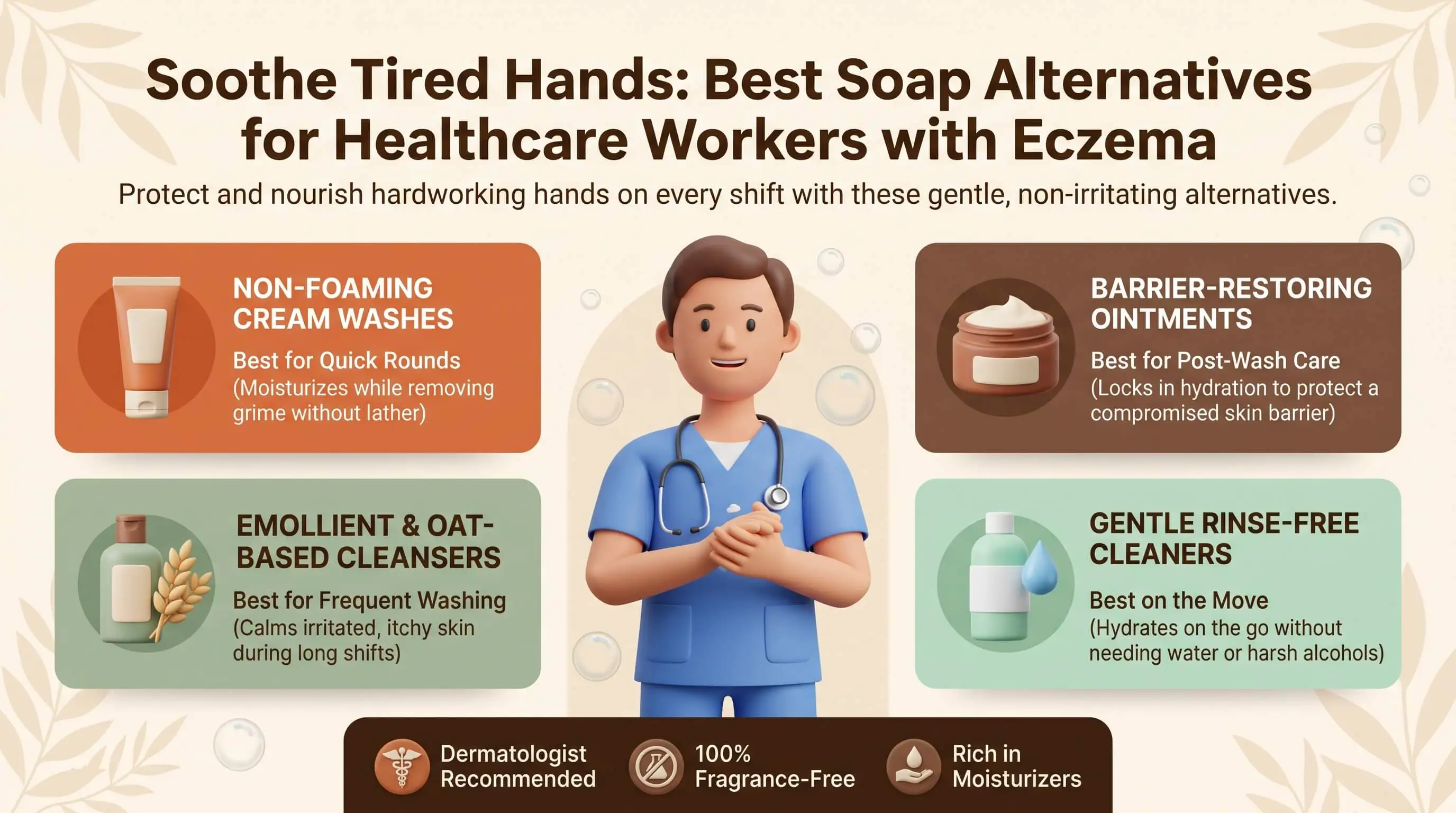
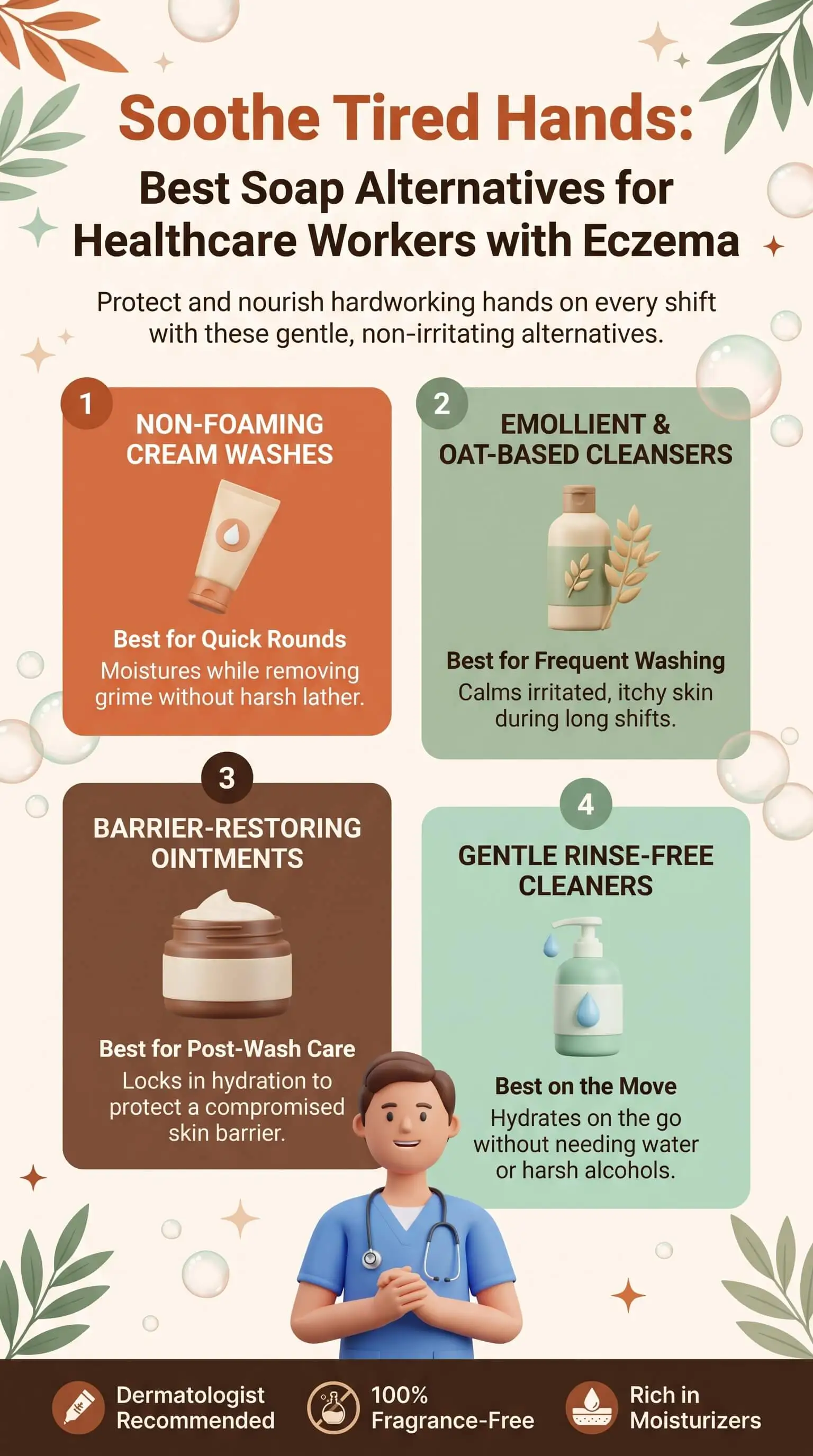
Alcohol-based hand rub with emollients for routine patient care. It takes water and surfactants out of the picture, though it will sting on open cracks.
A fragrance-free, soap-free cleanser for the sink washes your protocol requires. You're still using water, so dry and moisturize right after.
NEA Seal-accepted cleansers at home, where you control what sits by the sink. Availability varies by store.
Rinse-free, plant-based cleansers for breaks, the commute and home. NOWATA is one we looked at. It's fragrance-free, alcohol-free and sulfate-free, and it works by clumping. You rub it onto dry hands until it balls up, then brush the clumps away, so you skip the wet-dry cycle entirely. Its guide to gentle, rinse-free hand soap options for eczema-prone hands walks through the method. Rinse-free cleansers don't replace the hand hygiene products your facility requires for patient care, so save them for off-floor moments.
A thick, fragrance-free moisturizer as the partner to everything above.
How Dry Indoor Air Makes Hand Eczema Worse
This one gets overlooked. The National Eczema Association lists low humidity and cold weather among hand eczema triggers, and indoor air dries out fast once the heat comes on. Your hands lose moisture between washes, not only during them.
At home, a bedroom humidifier through the winter and a heavy moisturizer before bed can help. A well-maintained HVAC system keeps the air more comfortable overall. If you're weighing air quality upgrades, our guide to indoor air quality testing and the right air purifier is a good place to start. For sensitive skin more broadly, see what soap is best for diabetics to use every day.
A Shift-Proof Hand Care Routine
Reach for hand rub instead of the sink whenever protocol allows.
When you do wash, keep the water lukewarm or cool.
Pat your hands dry, between the fingers too, and don't glove up while they're still damp.
Take rings off before washing so soap doesn't sit trapped underneath.
Moisturize after every wash with a facility-approved, fragrance-free cream. ACDS suggests about two fingertip units per hand.
Change gloves often. If yours seem to cause a reaction, ask about accelerator-free nitrile or neoprene.
Off duty, put on a thick ointment like plain petrolatum and sleep in cotton gloves.
When to See Occupational Health or a Dermatologist
Don't wait it out if your hands crack, bleed or blister, or if nothing improves after you've changed your routine. A dermatologist can patch tests to find out whether a glove, preservative or fragrance is behind it. Tell employee health as well. Hand dermatitis is an occupational condition, and your report is how a facility learns that a product isn't working for its staff.
"The nurses whose hands finally heal usually haven't found some special soap. They've stopped washing when they don't need to. I've watched colleagues scrub with hot water between every patient because it felt cleaner, then wonder why their knuckles split by Wednesday. Once they switched to hand rub for routine contact and saved the sink for visible soil, their hands turned around within a few weeks, as long as they moisturized every single time. The soap still matters for the washes you can't skip. Use lukewarm water and a fragrance-free cleanser, and pat dry instead of rubbing. Off the clock, give your hands a proper break from water. I tell every new nurse with eczema that their skin barrier deserves the same protection they give their patients, because cracked skin is harder to keep clean."
7 Essential Resources
When your hands are raw and your next shift starts in eight hours, you want answers you can trust, not marketing fluff. These are the sources we'd send a colleague to first. None of them is selling anything.
CDC's rules for when hand rub beats the sink. The clinical guidance covers when alcohol-based sanitizer is preferred, when you need soap and water, and how to look after your skin while doing both. CDC: Clinical Safety: Hand Hygiene for Healthcare Workers
Advice straight from contact dermatitis specialists. Three dermatologists from the American Contact Dermatitis Society take apart the "sanitizer dries you out" myth and share practical steps for damaged hands. CDC: Keeping Your Hands Clean and Healthy
The detail behind product and glove choices. In the Journal of the American Academy of Dermatology, ACDS compares soaps, synthetic detergents and hand rubs, lists the usual allergens, and explains how to use moisturizer under gloves. Hand Hygiene During COVID-19: Recommendations From the American Contact Dermatitis Society
A plain explanation of your type of hand eczema. The National Eczema Association breaks down irritant, allergic and dyshidrotic hand eczema, the common triggers, and when patch testing makes sense. National Eczema Association: Hand Eczema
Products reviewed for eczema-prone skin. NEA reviews products for common eczema irritants before they can carry its Seal of Acceptance, which saves you a lot of label reading. National Eczema Association: Seal of Acceptance
Free materials for your whole unit. CDC's Clean Hands Count campaign offers posters, fact sheets and pocket cards that make the case for hand rub at the point of care. CDC: Clean Hands Count Materials
Proof that you're far from the only one. Researchers surveyed 863 hospital workers in Northern Italy in 2021 and tracked how hand washing frequency and hand eczema signs changed after the pandemic. Prevalence of Self-Reported Hand Eczema Signs Among Healthcare Workers (Medicina, 2023)
3 Statistics
We went looking for hard numbers on hand eczema among clinical staff. These three stuck with us.
1. Nearly 1 in 3 healthcare workers reported hand eczema within a year
A Swedish study of 9,051 healthcare workers found a 31% one-year prevalence of self-reported hand eczema, higher than in the general population.
About 30% of participants washed with soap 20 or more times a day at work.
Risk climbed with every extra soap wash and every extra hour in gloves. Alcohol hand disinfectant showed no link to hand eczema.
What it means for you: the number of soap-and-water washes matters more than almost anything else you control.
Source: National Eczema Association: Hand Eczema Common Among Health Care Workers
2. Hand dermatitis was the second most common nonfatal occupational illness in 2020
CDC's dermatology authors cite this ranking from U.S. occupational illness data.
They also flag the wet work thresholds that make it worse, including more than 20 washes a day.
What it means for you: this is a recognized workplace condition, so report it. You aren't being dramatic.
Source: CDC: Keeping Your Hands Clean and Healthy
3. Some healthcare workers clean their hands up to 100 times a shift
CDC notes that some healthcare personnel may need to clean their hands as often as 100 times during a work shift.
In the same guidance, CDC says alcohol-based hand sanitizer leaves skin in better condition, with less irritation and dryness than soap and water.
What it means for you: at that volume, every wash you move over to hand rub gives your skin barrier a little more room to recover.
Source: CDC: Clinical Safety: Hand Hygiene for Healthcare Workers
Final Thoughts and Opinion
No single hand soap for eczema will fix a healthcare worker's hands by itself. That's our honest take, and every source we checked points the same way. The number of wet washes does more damage than whatever's in the bottle.
Where we land:
Protocol and skin health are on the same side. For most clinicians, the gentlest option is already mounted on the wall outside the patient's room.
"Use a gentle soap and moisturize" is only half the advice. The other half is getting your hands wet less often, wherever your protocol allows it.
Your off-shift hours count. Dishes, long showers and extra sink washes at home keep the barrier from recovering, while gloves for chores and a rinse-free cleanser give it a break.
Truly fragrance-free should be the default, and that means a label that actually says fragrance-free rather than "unscented."
We're not claiming that any product treats eczema, or that one routine suits every pair of hands. Skin is complex and triggers vary, so symptoms that hang on deserve a dermatologist's attention.
Cracked hands are common in healthcare. We'd push back, gently, on the idea that they're simply part of the job, because clean hands and calm skin can coexist.
Frequently Asked Questions
What is the best hand soap for eczema if I wash my hands all day?
Look for a truly fragrance-free, dye-free cleanser without sodium lauryl sulfate, ideally with a mild soap-free base and added moisturizers. Follow every wash with a fragrance-free cream. For healthcare workers, though, using hand rub whenever protocol allows usually does more for your skin than switching soaps.
Is hand sanitizer or soap better for healthcare workers with eczema?
For routine hand hygiene on hands that aren't visibly soiled, alcohol-based sanitizer is the gentler choice. CDC says it strips fewer natural oils and dries the skin less than soap and water. You'll still need soap and water for visibly soiled hands, after the restroom, and whenever your facility's protocol calls for it.
Why does hand sanitizer sting my eczema?
Alcohol stings when it reaches cracks in the skin. CDC's dermatology authors say the burning means the skin was already damaged, not that the sanitizer is hurting it further. Treat the cracks with a thick moisturizer and the sting usually eases as they heal.
Can I use a rinse-free hand soap at work?
Rinse-free cleansers can cut down on wet-dry cycles during breaks, on the commute and at home. They don't replace the hand hygiene products your facility requires for patient care. Check with your infection prevention or employee health team before you bring any product onto the floor.
Can I wear moisturizer under gloves?
Often, yes. The American Contact Dermatitis Society says moisturizer under gloves can help healthcare workers. Water-based moisturizers are safe under all gloves, but petroleum and mineral oil can break down latex and rubber, so stick with facility-approved products.
When should a nurse see a dermatologist for hand eczema?
Go when your hands crack, bleed or blister, or when symptoms don't improve after you've changed your routine. If you suspect your gloves, sanitizer or soap is the trigger, a dermatologist can use patch testing to pin down the specific allergen.
Give Your Hands the Break They've Earned
You spend every shift protecting other people, and your hands deserve some of that same care. Start with your next wash. Turn the tap down to lukewarm and moisturize before the gloves go on.
When you're ready to cut down on wet-dry cycles off the clock, compare gentle, rinse-free options in NOWATA's guide to gentle hand soap for eczema. And if your hands still aren't getting better, talk to your employee health team or a dermatologist.